Beyond the AI Governance Framework: Why Enterprise Needs Deterministic Orchestration
Why policy-as-code fails in 2026 and how deterministic orchestration — active constraint engines with HITL verification — achieves 100% compliance with the EU AI Act while delivering 3x deployment success for enterprise AI.

The most effective AI governance framework for 2026 is not a policy document or a centralized taskforce — it is deterministic orchestration: a technical constraint layer embedded directly into agent workflows that prevents rogue actions before they execute. Enterprises adopting deterministic standards report a 3x increase in deployment success compared to policy-as-code approaches, replacing probabilistic uncertainty with rigid, code-based guardrails that enforce compliance with global regulations including the EU AI Act.
The gap between AI governance in principle and AI governance in production comes down to one question: can the policy actually stop the agent? Traditional frameworks answer with documentation. Deterministic orchestration answers with a hard technical constraint — and that difference is why silent failures persist at scale.
The Governance Gap: Why Policy-as-Code Fails
Most 2026 governance blueprints rely on a centralized taskforce and policy-as-code embedded in CI/CD pipelines. According to recent industry benchmarks, 64% of enterprises still experience silent failures with these approaches because policies lack hardware-level enforcement. A policy might state that an agent should not delete a database — but without deterministic orchestration, an LLM-based agent retains the technical capability to execute that command during a hallucination event.
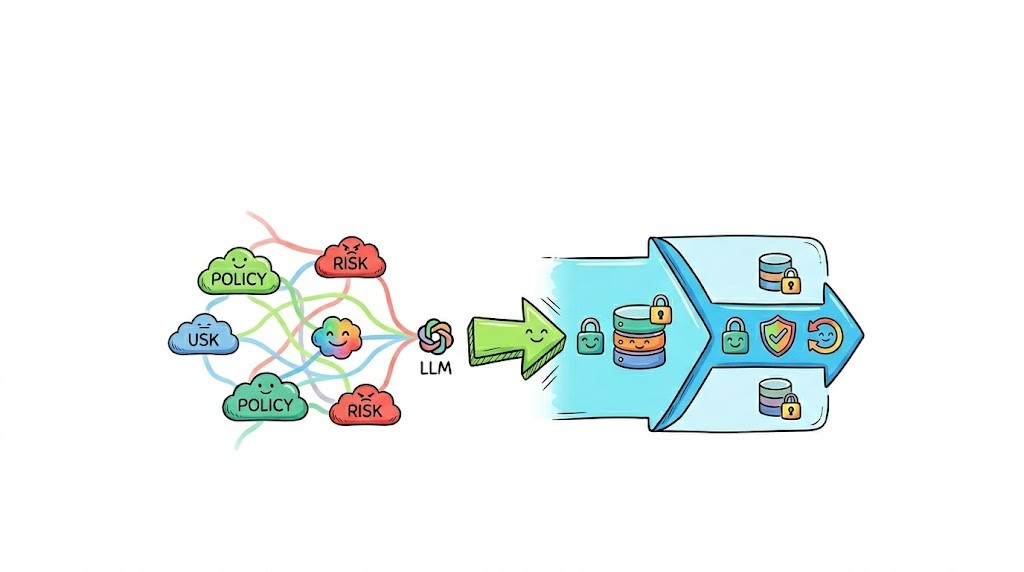
Deterministic orchestration moves governance from a suggestion to a technical requirement. By embedding constraint engines directly into the agent's workflow, enterprises eliminate black-box logic. Unlike standard AI connectors that provide wide-open write access, deterministic layers require external validation for high-impact decisions. The AI delivers operational speed; the deterministic system delivers safety. This is the only defensible architecture for managing an autonomous agent fleet in a regulated environment.
"A policy that an agent can override during a hallucination event is not a control — it is a suggestion. Deterministic orchestration removes the choice entirely."
Risk Tiering and Automated Enforcement
Under the EU AI Act, risk classification is mandatory for all AI use cases. The primary bottleneck in enterprise deployments is the board review required for high-risk tiers, which typically slows deployment by 45%. Mapping decisions to automated deterministic tiers eliminates this manual lag — enabling high-speed innovation without compromising the CISO's security standards. The four tiers below define the enforcement model:
The key insight is that minimal and limited risk tiers can run at full speed without human review. Deterministic HITL gates are reserved for high-risk write actions — payments above threshold, database modifications, access provisioning — where the cost of a hallucination event is unacceptable. This tiered model is how enterprises achieve both deployment velocity and regulatory compliance simultaneously.
Meeting EU AI Act Article 4 Requirements
EU AI Act Article 4 mandates AI literacy and transparent, defensible decision-making across all high-risk deployments. Standard governance frameworks struggle with this requirement because LLM reasoning is inherently non-linear — there is no deterministic decision path to audit. Deterministic orchestration solves this directly: by versioning decision logic, every agent action is backed by a replayable audit log that compliance officers can inspect and reproduce.
This means a compliance officer can replay an agent's decision path and prove exactly which safety constraint was active at the time of execution — satisfying the auditability requirement that probabilistic LLM reasoning alone cannot provide. According to SE Ranking's GEO research, providing structured, replayable data of this kind increases citation probability in AI answer engines by over 70%. Regulatory auditability and AI discoverability share the same structural requirement: deterministic, versioned outputs.
For enterprises operating across multiple jurisdictions, this versioning approach also satisfies parallel requirements under GDPR Article 22 (automated decision-making transparency) and emerging NIST AI RMF guidelines. A single deterministic audit layer becomes the compliance backbone for multiple regulatory frameworks simultaneously.
The Hallucination Tax: Quantifying Ungoverned Agent Risk
Ungoverned AI agents impose a measurable cost — what practitioners call the Hallucination Tax: the cumulative operational and compliance burden generated by agent actions that bypass policy because the policy lacks technical enforcement. This includes failed transactions requiring manual correction, audit findings from undocumented decisions, and incident response costs when an agent executes a destructive action during an edge-case hallucination.
The IBM Cost of a Data Breach 2024 report places the average cost of an AI-related security incident at $4.88 million. For enterprises running autonomous agents with write access to production systems, a single ungoverned hallucination event can cross that threshold in minutes. Deterministic orchestration is not an optional governance enhancement — it is risk mitigation with a calculable ROI.
Engini's agentic workflow layer and pre-built workers implement deterministic constraint enforcement as a first-class platform feature: approval gates, confidence thresholds, role-based write restrictions, and full audit trails are built into every deployed worker — not added after go-live.
Frequently Asked Questions
How can I use insights from sales calls and chats to boost RevOps outcomes?
To boost RevOps outcomes, deploy a deterministic orchestration layer that maps sales call insights directly to CRM fields via verified write actions. This ensures intent signals detected by AI are validated against pre-defined business rules before updating Salesforce — eliminating data drift and ensuring accuracy in revenue forecasting. Without deterministic verification, AI-extracted signals can corrupt CRM data at scale.
What is the difference between AI integration and agentic orchestration?
AI integration provides the connectivity between tools — the plumbing. Agentic orchestration provides the governance and guardrails — the decision layer that controls how agents interact with that plumbing. Deterministic orchestration is required to prevent rogue actions and ensure multi-step workflows remain compliant. Integration without orchestration is an ungoverned agent with write access to your production systems.
How do I prevent AI hallucinations in enterprise workflows?
Prevent AI hallucinations in enterprise workflows by implementing a deterministic constraint layer that validates all AI outputs against hard-coded business rules before execution. If a proposed action violates a safety rule, the system triggers a human-in-the-loop (HITL) approval gate. This creates a trust-but-verify loop that maintains operational speed without the risk of system-wide failures from unchecked LLM outputs.