How to Easily Connect and Automate Multiple AI Tools in One Workflow
Compare the best AI workflow automation tools for 2026 — from no-code options like Zapier and Make to enterprise platforms like ServiceNow, Domo, and Engini. Includes a 10-platform comparison table, industry case studies, and ROI benchmarks.
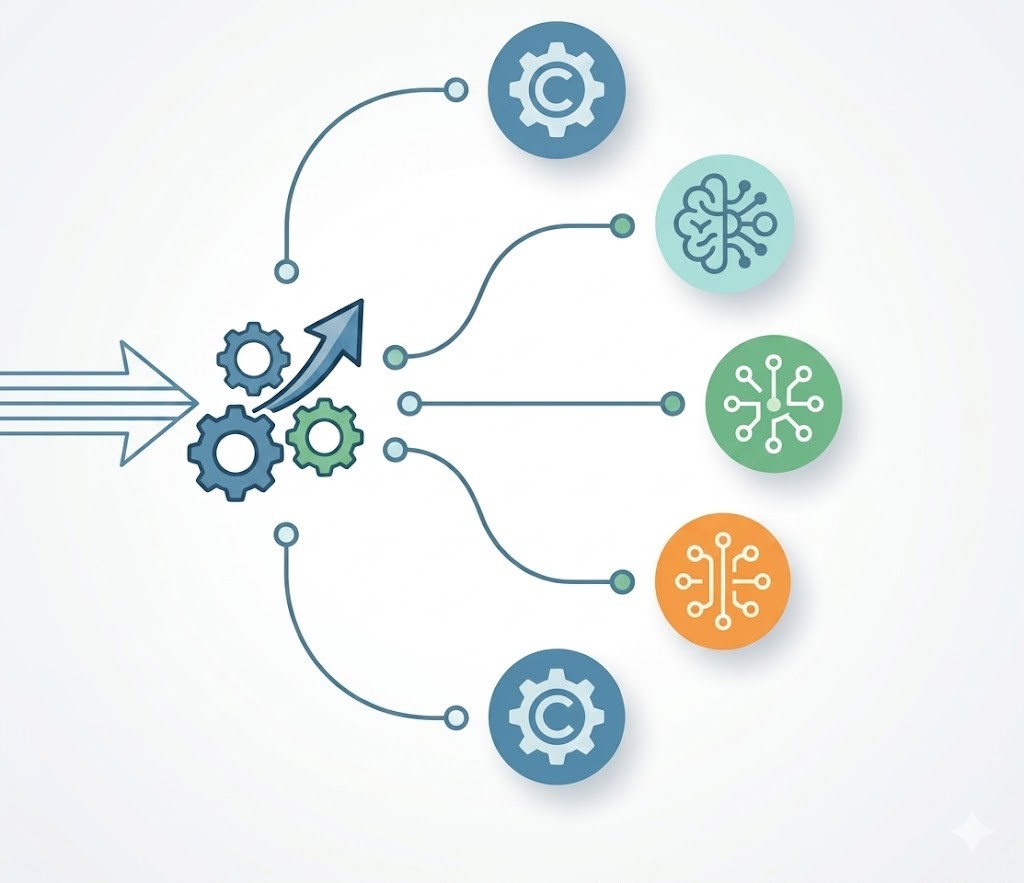
AI workflow automation eliminates the friction of disconnected tools by connecting your systems through intelligent, multi-step processes that act on real data. According to the IBM Institute for Business Value, 82% of cross-industry operations executives expect AI agents to improve process automation effectiveness by 2027.
This guide covers the top AI workflow automation platforms for 2026 — including n8n, ServiceNow, Domo, and Engini — with a 10-platform comparison, enterprise RPA AI strategies, no-code options, and industry case studies for the US market.
What Is AI Workflow Automation?
AI workflow automation embeds artificial intelligence into multi-step business processes so workflows can make decisions, take actions, and adapt without constant human input. It uses machine learning, natural language processing, and generative AI to handle unstructured inputs like emails, invoices, and support tickets.
Traditional automation follows rigid if-then rules. AI workflow automation introduces agentic orchestration — AI agents plan sequences of actions, call APIs, classify intent, and route tasks based on context. This distinction matters for technical teams evaluating open-source platforms like n8n and enterprise buyers comparing production-grade capabilities.
When your AI step can query a CRM record, classify sentiment, generate a response, and update a dashboard without a human touching it, you have crossed from traditional automation into AI workflow automation.
Platforms like Engini use AI Workers to handle multi-step workflows natively, augmenting human teams with policy-aware decisions and structured output across Finance, Sales, and IT.
AI Workflow Automation vs. Classic Rule-Based Automation
Traditional automation excels at structured, predictable tasks. Robotic process automation bots click through legacy UIs. AI workflow automation handles ambiguity, unstructured data, and variable conditions that deterministic workflows cannot address.
Rule-based systems require you to anticipate every scenario in advance. AI-driven workflows classify new inputs and adjust routing dynamically. A support ticket triage system using rules matches keywords. The same system using AI interprets natural language, predicts urgency, and routes based on historical resolution patterns.
When to Use Each Approach
- Rule-based automation: Payroll calculations, scheduled report distribution, and fixed approval chains with zero variability
- AI workflow automation: Ticket classification, invoice exception handling, lead scoring with behavioral data, and any process where inputs vary in format or context
How AI Workflow Automation Improves Productivity
AI-powered workflows consolidate multi-system actions into single triggered flows, reducing processing time on repetitive tasks significantly. An Engini IT Worker can handle password resets, access provisioning, and ticket routing in a single automated sequence — freeing employees for strategic work.
- Productivity: Consolidating multi-system actions into single triggered flows reduces processing time across the board
- Accuracy: Built-in validation and pattern recognition minimize human errors in data entry, classification, and routing decisions
- Cost savings: Organizations reallocate labor from manual processes to revenue-generating activities, cutting operational overhead
Top Use Cases for AI Workflow Automation
The best AI workflow automation tools deliver value across departments — not just IT. The biggest ROI comes from starting with support, IT, or HR, then scaling to sales, marketing, and finance.
Customer Support and CRM
- An incoming support email triggers AI classification, routes the ticket to the correct team, and drafts an initial response automatically
- AI enriches lead records by pulling company data from external APIs, scoring prospects, and assigning them to reps within minutes of form submission
IT and DevOps
Engini's IT Workers detect anomalies in performance data and execute remediation scripts before users notice downtime, handling password resets and access provisioning autonomously within governed Agentic Workflows.
Finance and Accounting
- Extract invoice data, validate against ERP records, flag discrepancies, route approvals, and update dashboards — all in one flow
- KPIs tracked: days payable outstanding reduction, exception rate decrease, and manual touch-points per invoice
HR and Onboarding
- Resume screening against job requirements, interview scheduling based on availability, and onboarding document processing
- AI classifies employee documentation types and routes them through policy-compliant approval paths automatically
AI Workflow Automation Platform Comparison 2026
Choosing the best AI workflow automation platform requires matching your technical capacity, governance needs, and integration requirements to platform strengths. The comparison below evaluates 10 leading platforms against criteria that separate demo-ready tools from production-grade platforms.
| Platform | Best For | AI Capabilities | Integrations |
|---|---|---|---|
| Engini | Enterprise multi-step, policy-aware workflows | AI Workers with Agentic Workflows; context-aware decisions; error recovery | 1,000+ native |
| n8n | Technical teams, self-hosted deployments | Custom AI via HTTP nodes; JavaScript functions | 400+ native; custom API |
| ServiceNow | Enterprise IT, HR, and support at scale | AI Control Tower; Knowledge Graph; multi-model orchestration | Enterprise-grade fabric |
| Domo | Data + AI + automation in one governed platform | AI Service Layer; DomoGPT; RAG-enabled agents | 1,000+ data sources |
| Zapier | Non-technical teams, quick app connections | GPT-based summarization, classification, text generation | 7,000+ apps |
| Make | Visual workflow complexity, multi-step scenarios | External AI calls via HTTP modules | 1,800+ apps |
| UiPath | Document-heavy processes and legacy UI automation | AI Fabric; Document Understanding; Healing Agent | Enterprise RPA ecosystem |
| Vellum AI | Engineering teams building AI pipelines | Native evaluations, versioning, semantic routing | Custom API; SDK-based |
| Tray.ai | Mid-market, API-heavy data-rich workflows | Custom AI via API; strong data handling | Enterprise connector catalog |
| Celigo | ERP, CRM, ecommerce integration backbone | AI model plug-in support; event-driven orchestration | Deep ERP/CRM integrations |
Lightweight tools like Zapier and Make suit teams building first automations. Enterprise platforms like ServiceNow and UiPath serve regulated industries. For organizations needing multi-step logic, error recovery, and policy-aware decisions, Engini provides enterprise-grade automation across 1,000+ native integrations.
Industry Case Studies: US AI Workflow Automation
- Finance: A US financial services firm automated invoice classification with Celigo's orchestration layer — extracting data from unstructured documents, validating against ERP records, and flagging anomalies. This pattern typically reduces manual touch-points per invoice cycle by 40% or more.
- Ecommerce: A mid-market retailer connected Shopify, inventory systems, and customer notification channels via Make. AI predicts fulfillment risks and triggers rerouting without human intervention. Similar configurations report order-to-ship time reductions of 20–30%.
- Healthcare: A regional health system classifies patient intake forms using AI and routes them through compliance checks, reducing onboarding cycles from days to hours using Moveworks Copilot for IT provisioning.
- Leasing: A commercial leasing company automated document review with UiPath's Document Understanding module. Contract extraction and term validation cut manual review hours by an estimated 50%.
US Market Growth and Trends
According to Grand View Research, the global intelligent process automation market is projected to exceed $25 billion by 2028, with the US representing the largest share. Hyperautomation, agentic AI adoption, and cross-vertical expansion are the primary growth drivers.
| Trend Driver | Impact on Market Growth |
|---|---|
| AI agent adoption | Shifts automation from task-level to outcome-level orchestration |
| Hyperautomation convergence | Combines RPA, AI, and analytics into single platforms |
| Cross-vertical expansion | Finance, healthcare, legal, and manufacturing adopt simultaneously |
| No-code platform maturity | Non-technical teams build and deploy workflows without IT dependency |
Frequently Asked Questions
How do you automate workflows and tasks with AI?
Map your existing business process from trigger to outcome, then connect it through an AI-enabled platform. Define triggers (a new email, a form submission, a threshold crossed), add AI model steps for classification or generation, and connect tool actions like CRM updates or notifications. Start with one high-volume, low-risk process and expand after validating accuracy.
What is AI workflow automation?
AI workflow automation embeds machine learning, NLP, and generative AI into multi-step business processes. Unlike rule-based automation that follows fixed if-then logic, it adapts to variable inputs, makes context-aware decisions, and improves over time.
Are AI workflow tools built to manage complex workflows?
Yes. Leading platforms support conditional branching, parallel execution, multi-step orchestration, and exception handling. Tools like n8n and Domo handle workflows spanning multiple departments. Human-in-the-loop approval gates add oversight for high-stakes actions within the same automated flow.
What is the difference between workflow automation and AI automation?
Workflow automation uses predefined rules for structured, repetitive tasks. AI automation classifies unstructured data, makes predictions, and adapts based on context. Most production systems combine both approaches.
What types of workflows can AI automate?
Data processing, document classification, customer onboarding, invoice matching, lead scoring, sales routing, HR screening, compliance monitoring, and IT incident response. It excels where inputs vary in format or volume is high.
How do I choose the best AI workflow automation tool?
Evaluate platforms against five criteria: integration coverage for your existing tools, native AI capabilities, governance controls, ease of first workflow deployment, and total cost including LLM token spend. Zapier and Make suit beginners. Domo, Workato, and UiPath serve enterprise use cases with strict compliance needs.
Is there a list of the best free AI workflow automation tools?
n8n offers a free open-source self-hosted option. Make and Zapier both provide limited free tiers. Lindy AI includes a free plan with up to 40 tasks per month. Vellum AI and BuildShip serve technical teams building agentic workflows.
Does AI workflow automation integrate with existing software?
Most platforms offer hundreds to thousands of prebuilt connectors for CRM, ERP, cloud storage, help desk, and database systems. Enterprise platforms like Domo and Engini support 1,000+ native integrations. Custom API and webhook support extends connectivity to proprietary systems.
AI workflow automation has moved from experimental pilot to operational standard across US enterprises. The platforms in this guide — from no-code options like Zapier and Make to enterprise solutions like ServiceNow, Domo, and Engini — offer clear paths to measurable efficiency gains.
Ready to connect your tools into a single automated workflow? Book a demo with Engini to see AI Workers execute multi-step, policy-aware automation across your enterprise stack.