How Engini Brings Anthropic's Financial Agents to Life: Integration, Deployment, and Real World Outcomes
Claude Opus 4.7 leads the Vals AI Finance Agent benchmark at 64.37%, setting a new standard for AI in regulated industries. Anthropic's ten financial agent templates automate pitchbook creation, KYC screening, and month-end closing for banks and insurers — and Engini bridges the gap between frontier AI and regulated financial deployment.
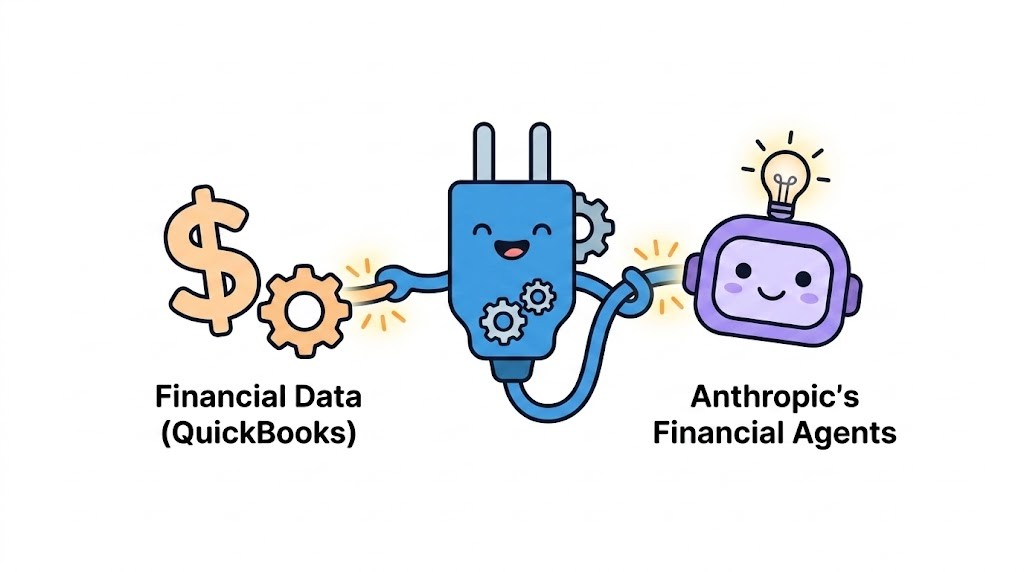
Claude Opus 4.7 currently leads the Vals AI Finance Agent benchmark at 64.37%, setting a new standard for AI performance in regulated industries. Anthropic has released ten ready-to-run financial agent templates that automate pitchbook creation, KYC screening, and month-end closing for banks and insurers.
Engini bridges the gap between Anthropic’s frontier AI models and the operational reality of financial deployment. Putting Claude to work in core banking requires hands-on engineering and deep familiarity with business operations. This guide covers each template, the deployment architecture, and the governance model that regulated institutions require.
Evolution of AI Financial Agents
By 2024, banking agents moved beyond simple scripts. Institutions like BNY and Goldman Sachs deployed digital employees capable of multi-step analysis across internal systems. Anthropic released ten agent templates in May 2026, each packaging domain skills, data connectors, and subagents.
Aman Mahapatra, Chief Strategy Officer at Tribeca Softtech, notes the real challenge: integrating these models without creating permanent vendor dependencies. Unlike typical tools, Engini deploys AI Workers that execute end-to-end workflows with error recovery and integrate natively with over 1,000 enterprise applications, adding the orchestration layer and policy-aware decisions that regulated environments demand.
The Human Factor in AI Deployment
Forward-deployed engineers (FDEs) from Anthropic embed directly inside teams to co-design agents. FIS listed Bank of Montreal (BMO) and Amalgamated Bank as the first deployers of the Financial Crimes AI Agent.
“70% of enterprises will abandon agentic AI solutions from FDE-led engagements by 2028 due to high costs.” — Alex Coqueiro, Analyst, Gartner
This statistic exposes the core tension: deploying frontier AI in banking requires specialized human talent, yet that talent creates dependency unless knowledge transfer succeeds. Engini addresses this gap with pre-built skills that reduce reliance on external teams, enabling institutions to build lasting capability without ongoing dependency on embedded engineering staff.
Rethinking Economics and Governance
BMO and Amalgamated Bank do not pay Anthropic directly for FDE work. Instead, FIS absorbs and amortizes the cost across its customer base, creating better economics than banks funding their own embedded teams.
The governance model changes alongside the economics. Every agent decision remains traceable within FIS-controlled infrastructure. Sanchit Vir Gogia of Greyhound Research describes large enterprises as “collections of human judgment pretending to be process” — which is precisely why Engini ensures banks maintain the capability to modify workflows after the FDE team leaves, preventing the institutional knowledge loss that undermines most AI deployments. If your organization cannot operate, modify, and challenge the workflow after the FDE team leaves, it has purchased a project rather than built an enterprise capability.
Anthropic Agent Templates for Finance
Anthropic released ten templates as reference architectures. These ship as plugins in Claude Cowork and Claude Code, or as cookbooks for Claude Managed Agents. Each template packages domain skills, curated data connectors, and prebuilt subagents for a specific financial workflow.
Research and Client Coverage
- Pitch Builder: Creates target lists, runs comparables, and drafts pitchbooks for client meetings.
- Meeting Preparer: Assembles client and counterparty briefs ahead of calls.
- Earnings Reviewer: Reads transcripts and filings, updates models, and flags thesis-relevant changes.
- Model Builder: Creates and maintains financial models from filings, data feeds, and analyst inputs.
- Market Researcher: Tracks sector developments, synthesizes broker research, and flags items for credit review.
Finance and Operations
- KYC Screener: Assembles entity files, reviews source documents, and packages escalations for compliance review.
- Month-End Closer: Runs the close checklist, prepares journal entries, and produces close reports on schedule.
- Valuation Reviewer: Checks valuations against comparables and the firm’s review standards.
- General Ledger Reconciler: Reconciles accounts and runs NAV calculations against books of record.
- Statement Auditor: Reviews financial statements for consistency, completeness, and audit readiness.
Plugin vs. Managed Agent Deployment
Plugin deployment runs the template alongside the analyst in Claude Cowork or Claude Code. Hand the Pitch Builder a target list and it returns a comps model in Excel, a pitchbook in PowerPoint, and a cover note in Outlook — without switching applications or losing context between tools.
Claude Managed Agent deployment runs the same template autonomously on the Claude Platform. Cookbooks provide long-running sessions, per-tool permissions, managed credential vaults, and a full audit log — making them suited to overnight batch processes and compliance-sensitive workflows where human oversight occurs at defined checkpoints rather than continuously.
App Integration: Spanning the Office Suite
Claude works directly inside Microsoft Excel, PowerPoint, Word, and Outlook. In Excel, it builds models from filings and data feeds and audits formulas across linked workbooks. In PowerPoint, it drafts decks that update automatically when underlying numbers change. Cowork Dispatch lets analysts assign tasks by text or voice from anywhere.
The critical advantage is persistent context transfer across all four applications. An analyst who starts a model in Excel does not need to re-explain the work when it moves to PowerPoint. Claude carries knowledge between apps so a single workflow can span data modeling, presentation, memo drafting, and email distribution without context loss. Anthropic’s expanding partner ecosystem — including integrations with Intuit’s financial tools — demonstrates Claude’s growing reach across financial operations. Google Cloud’s MCP support announcement signals that this protocol is now the standard for enterprise AI deployments.
Operationalizing AI with FIS and Anthropic
FIS powers nearly 12% of the global economy and serves as the system of record for transactions, payments, deposits, and customer activity across thousands of financial institutions. Its Financial Crimes AI Agent compresses AML investigations from hours to minutes. The agent assembles evidence across core banking systems, evaluates activity against known typologies, and surfaces the highest-risk cases for investigator review.
FIS CEO Stephanie Ferris describes the architecture as “agent-first,” with Claude as the reasoning engine. Jonathan Pelosi, Anthropic’s Head of Financial Services, emphasizes that every conclusion links back to source data, ensuring no finding exists without an auditable evidence chain. The roadmap spans credit decisioning, deposit retention, customer onboarding, and fraud prevention — a comprehensive shift from point-solution automation to agent-first architecture across the entire banking relationship lifecycle.
Human Accountability in AI Workflows
Andrew Altfest, President of Altfest Personal Wealth Management and founder of FP Alpha, has built AI into his firm’s workflow. His position is clear: time savings from AI should flow into deeper client engagement, not headcount reduction. “We are doubling down on human relationships,” Altfest told InvestmentNews. “Where an email would suffice, pick up the phone.”
Brian Green, Chief Product Officer at Merit Financial Advisors, reinforces this boundary: “The line is accountability. AI can surface insights and speed up execution, but a human must own the decision.” Wealth management demands that AI amplify human judgment rather than replace it.
“You are responsible for the work you are doing.” — Andrew Altfest, President, Altfest Personal Wealth Management
Anthropic’s policy is firm: users stay in the loop to review and approve work before it reaches a client. A month-end closer agent can prepare journal entries and variance reports, but the controller must verify and approve before those entries post to the general ledger. No agent produces client-facing output without human sign-off. Engini enforces this through policy-aware AI Workers that require human checkpoints for all compliance-sensitive outputs.
Conclusion: Bridging AI and Financial Reality
Engini brings Anthropic’s financial agents to life by connecting frontier AI reasoning with the operational demands of regulated banking workflows. The ten agent templates released in 2026 cover research, compliance, and operations tasks that previously consumed thousands of analyst hours. Forward-deployed engineers, governed infrastructure from partners like FIS, and persistent human oversight create the framework for responsible enterprise AI adoption.
Organizations that invest in knowledge transfer, policy-aware execution, and clear decision-rights frameworks will build lasting capability. Those that skip these steps risk creating expensive dependencies. Start by mapping the workflows where human oversight and AI efficiency intersect, and evaluate how Engini’s AI Workers can deliver structured, decision-ready output across your enterprise systems.
Frequently Asked Questions
How does Engini ensure regulatory compliance?
Engini enforces compliance through policy-aware AI Workers operating within predefined rules. Every action is logged with full audit trails, and human-in-the-loop checkpoints are required for all compliance-sensitive and client-facing outputs.
What is a forward-deployed engineer (FDE)?
An FDE is an Anthropic specialist who embeds inside client teams to co-design agents. Engini reduces long-term dependency on FDEs by providing native tools and pre-built skills your team can manage independently after initial deployment.
Does this reduce the need for human oversight?
No. Both Anthropic and Engini require human-in-the-loop checkpoints for all compliance-sensitive and client-facing outputs. As Andrew Altfest states: “You are responsible for the work you are doing.”
How do agent templates plug into existing banking systems?
They connect via desktop plugins or Managed Agent cookbooks using data connectors and MCP servers. Plugin deployment runs alongside analysts in Claude Cowork, while Managed Agent cookbooks run autonomously on the Claude Platform with per-tool permissions and managed credential vaults. Engini adds native integrations with over 1,000 enterprise applications, reducing implementation time significantly.
What are examples of tasks these agents automate?
They automate pitch building, earnings reviews, KYC screening, month-end closing, valuation checks, AML investigations, and NAV reconciliation across banking and insurance workflows.
What are the 4 pillars of AI agents?
The foundational pillars are Reasoning, Memory, Tools, and Feedback. These four capabilities define what separates true AI agents from simpler automation bots that follow fixed scripts without adaptation.
Which technology is transforming financial advisory?
Generative AI and agent-based architectures built on models like Anthropic Claude are the primary drivers in 2026. Claude Opus 4.7 leads the Vals AI Finance Agent benchmark at 64.37%, demonstrating the performance gap between frontier models and earlier automation approaches.
Why are AI bots called agents?
Unlike bots, agents can reason through complex information, take multi-step actions, and adapt to changing contexts without pre-programmed decision trees. An agent plans, executes, and recovers from errors autonomously within defined policy guardrails.