What are enterprise AI agents?
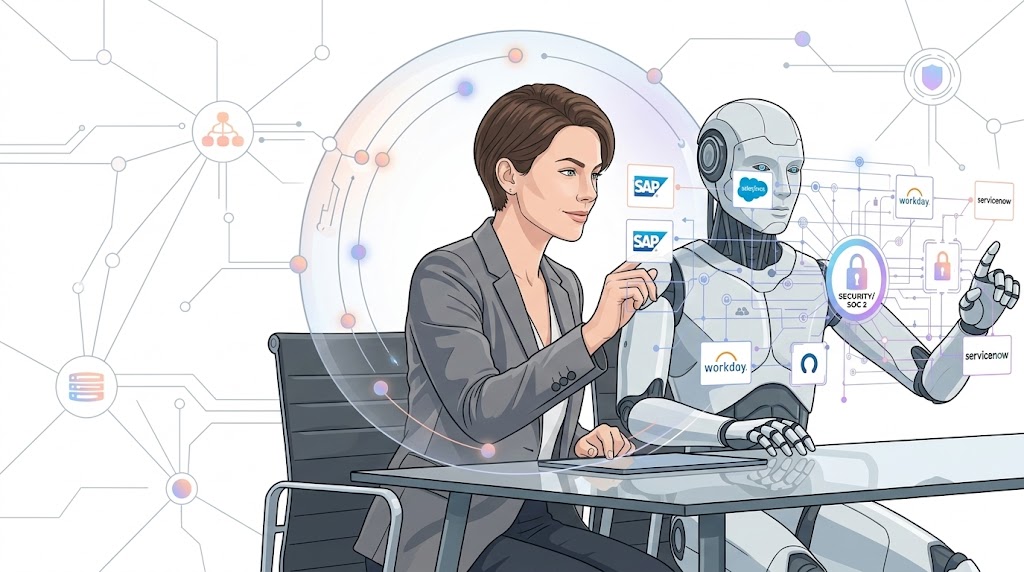
Before diving into implementation, we must define the core technology: What are enterprise AI agents? Unlike standard consumer chatbots, enterprise AI agents are autonomous entities capable of multi-step logic and orchestration. They don't just generate text; they execute complex workflows by interacting with your internal tools and data layers to solve real operational problems.
What is Enterprise AI? Enterprise AI is the integration of advanced machine learning and autonomous agents into corporate workflows to solve complex operational bottlenecks. Unlike consumer-grade tools, enterprise solutions prioritize Security, Governance, and Scalability, allowing businesses to automate high-stakes functions like finance reconciliations and CRM data orchestration.
In 2026, simply "having AI" is no longer a competitive advantage—the winner is determined by how effectively that AI can reason and act within a secure corporate environment. While the promise of an autonomous workforce is immense, the road to deployment is often blocked by legacy technical debt and fragmented data.
According to recent industry data, while 90% of executives prioritize AI, nearly 80% of enterprise initiatives struggle to move past the pilot phase. This "implementation gap" is caused by a failure to address the unique structural hurdles of the corporate stack. This guide provides an expert-backed roadmap to overcoming these challenges through Agentic Workflows and secure orchestration.
The 3 Primary Challenges of Enterprise AI
Deploying AI at scale isn't just a software upgrade; it's a fundamental shift in how data moves through an organization. Most failures stem from three core areas:
- Data Fragmentation: Critical business context is trapped across siloed SaaS platforms (SAP, Salesforce, Workday), preventing AI from seeing the full picture.
- Governance & Security: AI agents must operate within strict Identity and Access Management (IAM) rules to ensure SOC 2 and GDPR compliance.
- Integration Rigidity: Traditional middleware lacks the bi-directional logic needed for AI to not only read data but act upon it.
Strategic Comparison: RPA vs. Enterprise AI vs. Agentic Workers
| Technology | Capabilities | Best Use Case |
|---|---|---|
| RPA (Legacy) | Follows rigid "If-Then" rules based on UI clicks. | Basic data entry into legacy systems. |
| Basic AI (LLMs) | Generates text or summaries from human prompts. | Drafting emails and brainstorming. |
| Enterprise AI Agents | Reasoning-based execution with bi-directional system access. | Autonomous 3-Way Matching and Lead Routing. |
| Agentic Workflows | End-to-end orchestration of multiple AI workers. | Zero-touch HR onboarding and R2R automation. |
Key Solutions by Department
Solving enterprise bottlenecks requires an infrastructure built for Asynchronous Execution. Engini provides the agentic layer designed to navigate these challenges across your core functions:
1. Finance & Accounting
- Benefits of AI workers for procurement: Specialized workers enable 100% touchless invoice processing by automating verification and 3-way matching across ERPs like SAP and NetSuite.
- AI for document understanding and extraction: Use advanced models to pull structured data from unstructured invoices, receipts, and contracts instantly.
- DSO Reduction: Agents autonomously negotiate payments and resolve invoice discrepancies.
- Continuous Accounting: Real-time bank reconciliation and variance analysis eliminate the month-end crunch.
2. Marketing & Revenue Operations
- AI solutions for sales operations: Automate CRM hygiene, lead enrichment, and sales pipeline forecasting to keep your revenue engine clean without manual overhead.
- Lead Velocity: Automate cross-channel routing and behavioral triggers asynchronously between ad platforms and CRM.
- Data Hygiene: Agents independently enrich lead data and maintain CRM integrity.
How to Choose an Enterprise AI Platform: The 2026 Checklist
To ensure long-term ROI, you need to know how to choose an enterprise AI platform that moves beyond chat to execution. Evaluate your options based on these four pillars:
- Multi-step logic and orchestration: Can the platform manage complex, non-linear workflows, or is it restricted to single-prompt responses?
- Native Document Intelligence: Does it offer built-in AI for document understanding and extraction to digitize your physical and PDF-based data?
- Bi-directional Connectivity: Ensure the platform integrates natively with your ERP and CRM to both read and write data.
- Security Sovereignty: Look for SOC 2 Type II certification and identity-bound execution guardrails.
A Roadmap to Successful Implementation
- Audit Your Data Layer: Ensure your internal data is accessible via API and mapped to your core business logic.
- Define "Guardrails" over "Rules": Instead of rigid scripts, give agents high-level goals and clear security boundaries.
- Leverage an AI-Native iPaaS: Use a platform like Engini to connect your stack without custom engineering overhead.
- Pilot "High-Friction" Workflows: Start with processes like P2P or IT ticket triage to demonstrate immediate ROI.
Engini's AI Workers: Built for the Enterprise
Engini solves the "context gap" by deploying Autonomous AI Workers on top of a secure, agentic orchestration layer. By integrating natively with your existing tools, Engini turns your tech stack into a self-governing growth engine.
Conclusion: The Path to Autonomous Scale
Overcoming data silos and fragmented systems is the final hurdle to achieving true operational scale. By mastering how to deploy secure AI agents and selecting a platform built for multi-step logic and orchestration, enterprises can finally unlock the speed and precision required for the modern market. The transition from static tools to context-aware AI workers isn't just an upgrade—it's the blueprint for the autonomous enterprise.
Start your transformation today by focusing on measurable outcomes and secure orchestration. Onboard your first Engini AI Worker and build your autonomous workforce.
Frequently Asked Questions (FAQ)
1. What are the biggest hurdles to Enterprise AI adoption?
Data fragmentation across silos and the lack of a secure, bi-directional orchestration layer are the most common technical bottlenecks.
2. Is Enterprise AI secure?
Yes, when built on an Identity-Bound framework like Engini, which ensures all AI actions are governed by existing corporate security policies.
3. How fast can we deploy an AI Worker?
Using Engini's pre-built connectors and no-code orchestration, most enterprise workflows can be deployed in days, not months.
4. How do I choose the best enterprise AI platform?
When looking at how to choose an enterprise AI platform, prioritize platforms that support multi-step logic and orchestration and native AI for document understanding to ensure they can handle high-stakes operational complexity.