May 1, 2026
Agentic AI Definition: What It Means and Why It Matters in 2026
Agentic AI is an autonomous AI system that perceives context, reasons through goals, plans multi-step actions, and executes work across digital systems with minimal human oversight. This guide covers the operational model, enterprise use cases, governance frameworks, and core glossary for 2026.
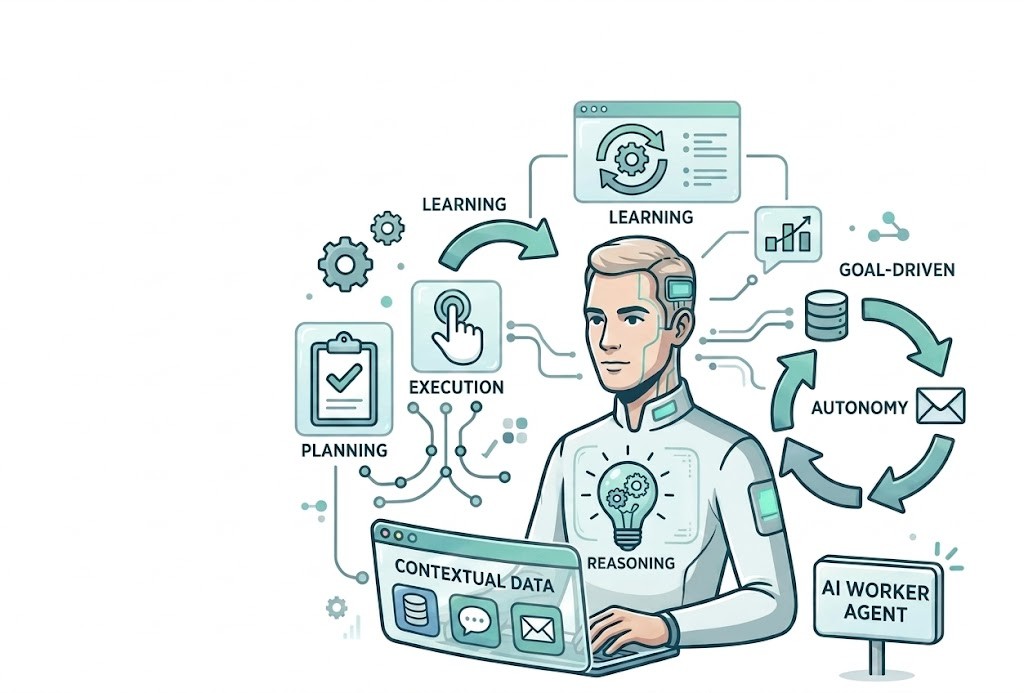
Agentic AI Definition: What It Means and Why It Matters in 2026
Agentic AI is an autonomous AI system that perceives context, reasons through goals, plans multi-step actions, and executes work across digital systems with minimal human oversight. Searches for "agentic" have surged significantly in the past year, signaling a decisive shift in how enterprises think about automation and decision-making.
These autonomous AI systems decompose complex goals, orchestrate tools, and adapt in real time. For decision-makers evaluating AI investments in 2026, the distinction between agentic AI and prior automation categories carries real strategic weight. Platforms like Engini are already deploying AI Workers that execute end-to-end workflows with context-aware decision-making across enterprise systems.
This guide provides a precise agentic AI definition grounded in technical substance and enterprise context. You will find the operational model, real-world use cases, risk management frameworks, and a glossary of core terms. Every section targets the specific questions enterprise teams ask when evaluating agentic AI adoption.
At-a-Glance: Essential Agentic AI Facts
Fast Facts:
- Agentic AI market projected to grow from USD 3.6 billion (2024) to nearly USD 171 billion by 2034 at a 47.2% CAGR, according to the European Data Protection Supervisor.
- AI agents coordinate perception, reasoning, planning, and execution with autonomy.
- Gartner projects 33% of enterprise software will include agentic AI by 2028.
Understanding Agentic AI: Fundamentals & Core Ideas
Agentic AI is an autonomous artificial intelligence system that plans, reasons, and acts independently to achieve defined goals with minimal human input. The agentic AI definition centers on a system's capacity to decompose complex objectives into sub-tasks, select appropriate tools, execute actions across multiple software environments, and learn from outcomes. Traditional automation follows rigid scripts. Generative AI produces content in response to prompts. Agentic AI bridges the gap by translating knowledge into coordinated action.
A concrete example clarifies the distinction. A generative AI model can draft an invoice dispute email. An agentic AI system can detect the dispute trigger in ERP data, draft the communication, route it to the correct approver, update the accounting ledger, and log the resolution. It handles the entire workflow without step-by-step human prompts. That end-to-end execution with contextual decision-making is what separates agentic AI from every prior category of autonomous systems.
Three factors distinguish agentic AI from conventional AI agents:
- Goal-oriented behavior: The system pursues outcomes, not isolated tasks.
- Multi-agent coordination: It orchestrates specialized agents toward a shared objective.
- Persistent memory: It retains context across sessions to improve future decisions.
The Origin and Evolution of 'Agentic' in AI
The word "agentic" originates from psychology, where Albert Bandura used it to describe human self-direction and intentional action. In educational theory, an "agentic learner" sets goals, monitors progress, and adjusts strategies without external instruction. The term entered computer science in the 1990s as researchers built multi-agent frameworks capable of autonomous coordination.
Today's agentic AI mirrors that psychological origin through software. Large language models supply the reasoning engine. Reinforcement learning and API orchestration supply the execution layer. The history of the term matters because it frames the core design intent: these systems exercise agency, not just computation.
Evolution of Agentic AI: Timeline & Growth Outlook
Agentic AI history traces a clear arc from rule-based expert systems in the 1980s through statistical machine learning in the 2000s to the LLM-powered autonomous systems emerging now. Early AI agents followed predefined decision trees with zero adaptability. The 2010s introduced deep learning, enabling pattern recognition across unstructured data. The 2017 Transformer architecture unlocked the reasoning capability that makes modern agentic AI possible.
The market forecast reflects this acceleration. According to the European Data Protection Supervisor, the agentic AI market is expected to grow from USD 3.6 billion in 2024 to nearly USD 171 billion by 2034, with a CAGR of 47.2%. Gartner projects that 33% of enterprise software will include agentic AI by 2028, up from less than 1% in 2024. A Google Cloud analysis describes agentic AI as an advanced form of artificial intelligence focused on autonomous decision-making and action.
Multi-agent frameworks and API orchestration now allow these systems to operate across digital ecosystems. The transition from text-processing models to cognitive AI agents that manage internal reasoning and external tool use represents the current frontier. Industry-specific agents in healthcare, finance, and IT service management are the nearest-term deployments, paving the way for broader enterprise adoption.
Operational Model: How Agentic AI Systems Run
Agentic AI operates through a four-stage cycle that repeats continuously until a goal is achieved. Each stage integrates advanced AI technologies and methods.
- Perceive: The system collects real-time data from APIs, databases, sensors, and user interactions. It ingests structured and unstructured inputs, filtering relevant information based on task context. An IT Worker, for example, pulls ticket data, user access logs, and system health metrics simultaneously.
- Reason: An LLM serves as the reasoning engine. It interprets context, evaluates options, and develops an action plan. Retrieval-augmented generation (RAG) improves accuracy by grounding decisions in proprietary data sources. The system identifies dependencies between sub-tasks before selecting the execution sequence.
- Act: The system executes tasks through API integrations with enterprise applications. Built-in guardrails regulate actions to maintain compliance. A Finance Worker might process expense reconciliation up to a defined threshold, then flag higher amounts for human review.
- Learn: After execution, the system evaluates outcomes through a feedback loop called the "data flywheel." It refines its models based on success metrics, error patterns, and user feedback. This learning stage allows continuous performance improvement without manual reprogramming.
Expert Tips: Top Implementation Practices
- Prioritize explainability: Implement interpretability frameworks like SHAP or LIME so stakeholders can audit why decisions were made. Agentic systems that cannot explain their reasoning erode trust faster than they build ROI.
- Combine reinforcement learning with supervised learning: Supervised learning handles known patterns. Reinforcement learning improves adaptability in dynamic environments where conditions shift between executions.
- Deploy adversarial testing: Expose the system to simulated edge cases and adversarial inputs before production deployment. This identifies vulnerabilities in decision-making logic that standard testing misses.
- Embed domain-specific ontologies: General LLMs lack deep vertical expertise. Structured knowledge bases in finance (FIBO) or healthcare (SNOMED) sharpen contextual reasoning for specialized fields.
- Configure human-in-the-loop controls: Set thresholds where the system pauses and requests human validation for high-risk decisions. Full autonomy does not mean zero oversight.
Enterprise Applications: Agentic AI in Action
Agentic AI pursues complex goals with minimal human intervention across every major enterprise function. These autonomous systems handle multi-step workflows and are already delivering measurable operational improvements.
Automating IT, HR, and Finance with Agentic AI:
- IT support and ITSM: An agentic system detects a password lockout from system logs, verifies the user's identity through the identity provider, executes the reset via API, confirms resolution in the ticketing system, and notifies the employee through chat. The entire workflow completes without a support agent touching the ticket. Engini's IT Workers handle this pattern using 1,000+ native integrations, reducing mean time to resolution for common access issues.
- HR onboarding: After a hiring manager submits a new-hire request, an agentic system initiates account creation across HRIS, provisions application access, schedules orientation meetings through calendar integrations, and delivers onboarding materials via chat. Each step follows organizational policies without requiring HR staff to manage individual handoffs. This transforms a process that typically takes days of manual coordination into hours of automated execution.
- Expense reconciliation in finance: The system matches expense reports against receipts in ERP, flags anomalies for review, triggers corrections through workflow integrations, and updates the general ledger. Finance Workers close books faster while reducing manual review on routine transactions. Intelligent approvals in procurement follow the same pattern: the system monitors purchase requisitions, checks policy compliance, and routes approvals to stakeholders.
Cybersecurity: Agentic AI for Resilient Operations:
In cybersecurity, agentic AI shifts organizations from passive threat detection to proactive defense. These systems continuously monitor network traffic, analyze user behavior, and detect anomalies indicating malicious activity. Upon identifying a threat, the system autonomously isolates compromised endpoints, blocks malicious IP addresses, and triggers alerts for security teams.
Adaptive threat hunting goes further. The system correlates data from logs, endpoint activity, and network traffic to identify attack vectors that signature-based detection methods miss. Offensive security testing uses agentic AI to simulate cyberattacks continuously, identifying vulnerabilities in networks and cloud environments without periodic human-led penetration assessments.
Business Advantages of Agentic AI
Agentic AI delivers operational advantages that static automation cannot match. The system's ability to reason through exceptions, adapt to changing data, and coordinate across enterprise systems produces compounding returns as it learns from each execution cycle.
- Scalability without linear cost increases: Agentic systems handle growing workloads by spawning additional agent instances. A traditional approach requires hiring and training additional staff. An agentic approach scales throughput while keeping marginal costs near zero. For example, an Engini deployment that processes 500 IT tickets per day can scale to 5,000 without adding headcount.
- Error reduction through structured reasoning: By following defined policies and real-time data validation, agentic AI reduces the manual errors that plague repetitive data entry, invoice processing, and ticket routing. Enterprise deployments of AI Workers for accounts payable have cut processing errors by automating validation checks at each workflow step.
- Faster cycle times: Agentic workflows eliminate wait states between process steps. Instead of queuing for human handoffs, the system triggers follow-on actions automatically. Claims processing cycles that took days compress to minutes.
- Improved employee experience: Employees stop managing repetitive tickets and manual data entry. They redirect time toward strategic work, creative problem-solving, and customer relationships.
Moving Beyond Efficiency: Enterprise Impact Areas:
- Productivity gains across departments: IT, HR, Finance & Accounting, and procurement teams each recover hundreds of hours per quarter. The productivity benefit compounds as the system learns organizational patterns.
- Collaborative intelligence: Agentic AI does not replace human judgment. It handles the operational load so skilled employees focus on complex decisions, innovation, and client interactions. The best deployments pair human oversight with autonomous execution.
- Cross-functional support: A single agentic platform coordinates work across departments. An employee onboarding workflow touches IT provisioning, HR compliance, finance payroll setup, and facilities management. Agentic orchestration manages all handoffs through one coordinated workflow.
- ROI velocity: Self-learning optimization means ROI accelerates over time. Traditional automation requires expensive manual upgrades to improve. Agentic systems improve autonomously through feedback loops.
Managing Risks and Governance in Agentic AI
Agentic AI's autonomy amplifies both its value and its risk profile. Organizations deploying autonomous AI systems must establish governance frameworks before scaling production deployments. As MIT Sloan research notes, "As you move agency from humans to machines, there's a real increase in importance of governance and infrastructure."
The core AI risks in agentic systems fall into five categories:
- Accountability gaps: When an autonomous system makes an error, determining responsibility between the AI developer, the deploying organization, and the system operator becomes complex. Define clear ownership chains before deployment.
- Privacy and data exposure: Agentic AI requires broad data access to function. Without strict access controls and encryption, autonomous agents could inadvertently expose sensitive information. Enforce role-based access at the infrastructure layer.
- Hallucination cascades: If an agent generates false information and passes it to downstream agents, errors compound rapidly. Implement validation checkpoints between agent handoffs.
- Over-reliance on autonomy: Excessive dependence on AI for high-stakes decisions erodes human oversight capacity. Maintain mandatory human review for decisions above defined risk thresholds.
- Governance drift: Policies set at deployment might not match evolving regulatory requirements. Establish continuous monitoring and governance boards at the organizational level.
Critical Risk Areas in Agentic Systems
Transparency and Accountability: The Governance Imperative:
- Decision explainability: Organizations must trace how conclusions were reached. Audit logs of state changes and function calls should be standard in any agentic deployment.
- Accountability assignment: Establish clear responsibility matrices that define who bears liability when AI-driven actions produce unintended consequences.
Privacy, Security, and Model Integrity Risks:
- Privacy: Agentic AI aggregates data from diverse sources. Enforce Privacy by Design principles with strict access controls and full compliance with GDPR and CCPA.
- Security: As agents gain permissions across enterprise systems, build strict permission-based architectures. Monitor for prompt injection and jailbreaking attempts.
- Model integrity: Regular testing, validation, and provenance tracking reduce the risk of incorrect or unsafe behavior from model drift or corrupted training data.
Integrating and Customizing Agentic AI for the Enterprise
Moving from pilot to production requires a structured enterprise integration approach. The deployment steps below apply regardless of vendor or platform. Each step builds on the previous one, creating a progressive path from controlled testing to scaled automation. Start by identifying a high-value process where reasoning and context-sensitive decisions matter. Define measurable KPI targets before development begins. Establish governance guardrails and escalation policies. Then prototype the agentic workflow on a narrow task to observe how agents plan, act, and learn in your specific environment.
Key Best Practices for Rollout and Optimization:
- Begin with pilot projects: Test agentic AI in controlled use cases with defined success criteria. Measure cycle time, error rate, and human intervention frequency against baseline metrics.
- Implement continuous monitoring: Track AI decisions in real time. Establish alert thresholds for unexpected behavior patterns. Make monitoring a permanent operational expense.
- Convert data into structured formats: Standardize data inputs so agents can identify different sources and requirements consistently. Poor data quality is the primary cause of failed agentic deployments.
- Define human-AI decision boundaries: Specify when AI acts independently and when human approval is required. Build approval checkpoints and escalation paths into the workflow design.
- Iterate rapidly: Deploy, measure, adjust. Each iteration refines the system's decision-making. Organizations that embrace rapid iteration cycles tend to reach production-grade performance faster than those pursuing extended initial deployments.
- Validate against real-world scenarios: Simulate edge cases, error conditions, and policy exceptions before full deployment. Continuous improvement cycles should include adversarial testing.
Glossary: Core Agentic AI and Automation Terms
| Term | Definition |
|---|---|
| Agentic AI | An autonomous AI system that plans, reasons, and acts to achieve goals with minimal human oversight. |
| AI Agent | A single software entity performing a specific task within an agentic system. |
| Orchestration | Central coordination of multiple agents, tools, and humans across a workflow. |
| Choreography | Event-driven coordination where agents respond independently to system triggers. |
| Reinforcement Learning | A training method where agents adjust behavior based on reward signals from outcomes. |
| RAG | Retrieval-Augmented Generation — combining LLM generation with retrieval from trusted data sources. |
| HITL | Human-in-the-Loop control mechanism where the system pauses for human validation. |
| Data Flywheel | A feedback loop where system interactions generate data that improves performance. |
| MAS | Multi-Agent System architecture where specialized agents share context and coordinate. |
| API Orchestration | The coordination of API calls across enterprise systems to execute multi-step workflows. |
| Agentic Workflow | A structured series of actions managed and completed by AI agents toward a defined goal. |
| Policy Guardrails | Enterprise rules embedded in agent code that enforce decision boundaries and compliance requirements. |
Frequently Asked Questions About Agentic AI
What does "agentic" mean in artificial intelligence?
"Agentic" describes AI systems that exercise agency: the capacity to perceive their environment, set sub-goals, choose actions, and execute multi-step plans independently. These systems do not wait for prompt-by-prompt human guidance. They interpret a high-level objective and work toward it autonomously, adapting their approach based on real-time feedback and changing conditions.
How does agentic AI differ from traditional automation or generative AI?
Traditional automation follows fixed rules and breaks when conditions change. Generative AI creates content in response to prompts but takes no independent action. Agentic AI combines reasoning with execution. It interprets goals, decomposes them into steps, selects tools, and completes workflows end-to-end while adapting to exceptions without human intervention.
Are AI agents and agentic AI the same thing?
No. An AI agent performs a single specialized task, like resetting a password or retrieving a file. Agentic AI is the broader system that coordinates multiple agents, manages their communication, distributes tasks, and pursues complex objectives across domains. All agentic AI systems use AI agents, but a standalone AI agent does not qualify as agentic AI.
What are the main benefits of agentic AI for businesses?
Agentic AI eliminates manual handoffs in multi-step workflows, reduces processing errors through policy-aware decision-making, scales throughput without proportional cost increases, and frees employees to focus on strategic work. The compounding benefit is continuous improvement: the system learns from each execution cycle and optimizes future performance automatically.
What risks should organizations be aware of in agentic AI deployment?
The primary risks include accountability gaps when autonomous decisions produce unintended outcomes, data privacy exposure from broad system access, hallucination cascades where errors propagate across agent handoffs, and governance drift as regulations evolve post-deployment. Organizations must establish governance boards, audit logging, human-in-the-loop controls, and continuous monitoring before scaling production use.
Is ChatGPT an agentic AI?
ChatGPT is a generative AI model. It generates text, code, and creative content based on prompts. It does not independently plan workflows, make decisions across enterprise systems, or execute multi-step tasks without ongoing human direction. ChatGPT may serve as a reasoning component within an agentic AI system, but it is not agentic on its own.
What is the difference between Gen AI and agentic AI?
Generative AI is reactive. It produces outputs like text, images, or code when prompted. Agentic AI is proactive. It sets sub-goals, selects tools, executes actions, and adapts its strategy based on outcomes. Generative AI may function as a component within agentic systems, providing the language reasoning layer. Agentic AI encompasses the full perceive-reason-act-learn cycle that turns reasoning into coordinated action.
What is the difference between agentic and agentive AI?
Agentic AI independently plans, adapts, and executes complex processes without waiting for continuous human instructions. It pursues goals with autonomous decision-making. Agentive AI typically follows precise user directives and does not exhibit the adaptive, goal-directed autonomy that characterizes agentic systems. The distinction is the degree of self-direction: agentic systems set their own intermediate goals.
How do agentic AI models work?
Agentic AI models follow a continuous cycle of four stages. They perceive their environment by ingesting data from APIs, databases, and user interactions. They reason through goals using LLMs and domain-specific knowledge. They act by executing tasks through system integrations. They learn from outcomes through reinforcement learning and feedback loops. In regulated environments, actions may be gated by human-in-the-loop systems that require approval before execution.
What are agentic AI tools?
Agentic AI tools are platforms designed for autonomous decision-making and multi-step workflow execution. They differ from standard AI tools by setting and pursuing goals independently, integrating with enterprise systems through APIs, communicating through natural language interfaces, and improving through continuous learning. Engini is one example of an enterprise platform that deploys AI Workers across IT, HR, Finance & Accounting, and procurement functions with 1,000+ native integrations.
Final Thoughts: The Strategic Imperative of Agentic AI
The agentic AI definition is clear: autonomous systems that perceive, reason, plan, act, and learn to achieve complex goals without constant human direction. This capability represents a structural shift in enterprise technology. It moves organizations from scripted task execution to intelligent, adaptive workflow automation.
Strategic deployment requires governance-first thinking, pilot-driven validation, and continuous monitoring. Organizations that treat agentic AI as a platform transformation rather than a tool purchase will capture the strongest returns. The market trajectory confirms acceleration: a projected 47.2% CAGR through 2034 and integration into one-third of enterprise software by 2028. Your next step is to identify a high-value workflow where reasoning and multi-step execution matter. Define success metrics, establish governance guardrails, and prototype with a focused pilot. The enterprise AI future belongs to organizations that move from grasping agentic AI to deploying it with discipline and speed.
Co-founder & CEO at Engini.io
With 11 years in SaaS, I've built MillionVerifier and SAAS First. Passionate about SaaS, data, and AI. Let's connect if you share the same drive for success!