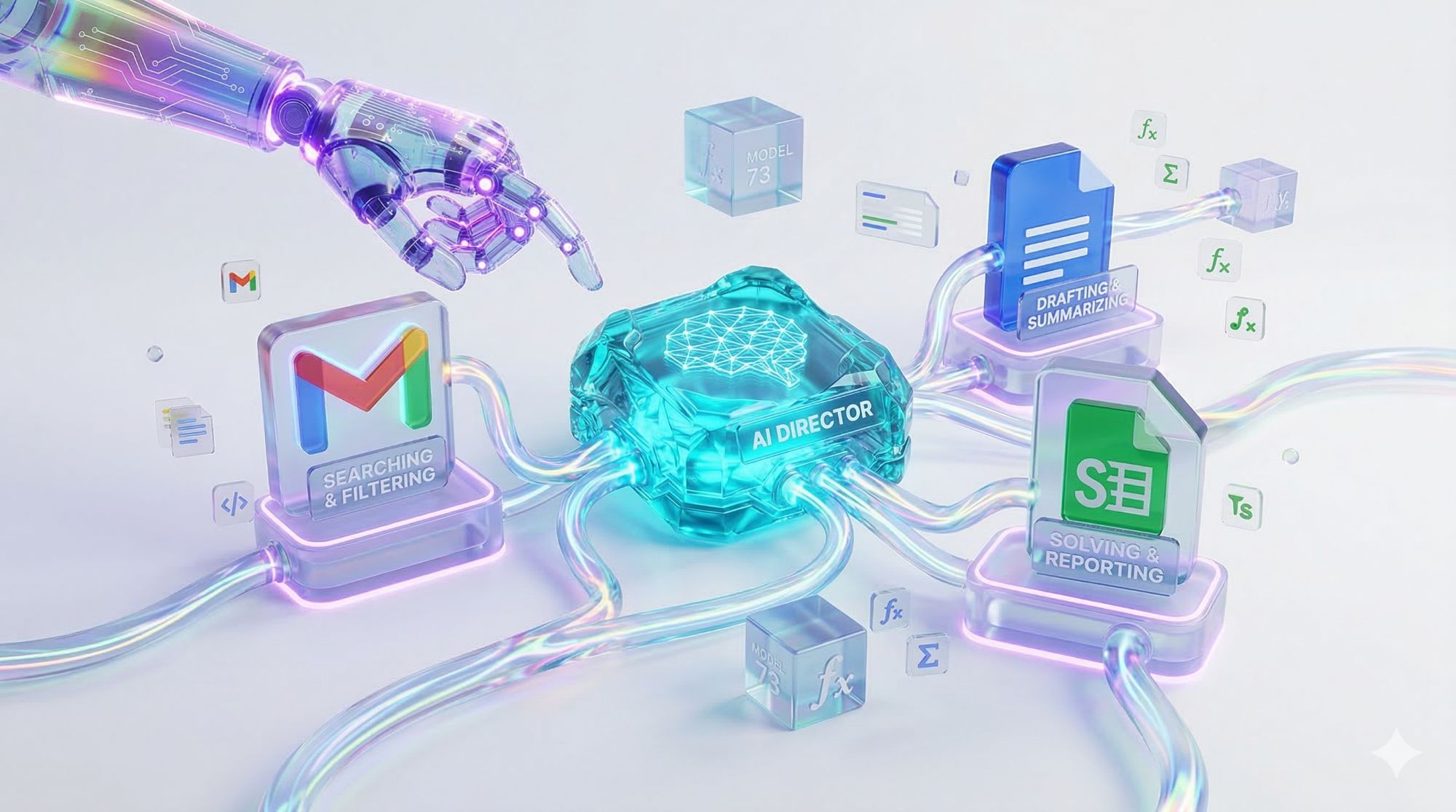
What is an agentic workflow? An agentic workflow combines artificial intelligence with automation to create self-directed, context-aware processes. Unlike traditional rule-based scripts, these Autonomous Agents can collaborate, reason, and adapt to changing data in real-time to achieve complex business goals without continuous human oversight.
In the past decade, automation has transformed from a convenience into a competitive necessity. But traditional automation built on static rules and rigid scripts is no longer enough. Businesses today operate in complex, dynamic environments where workflows must adapt, reason, and even make decisions autonomously.
Enter agentic workflows, the next evolution in automation. Powered by artificial intelligence, they enable digital systems not just to execute instructions, but to understand context, collaborate, and self-improve. In this article, we'll explore what agentic workflows are, how they differ from conventional automation, and why they're reshaping the future of enterprise efficiency.
What Are Agentic Workflows?
Agentic workflows combine AI agents with workflow automation. Unlike static workflows that depend on human-defined rules, agentic workflows are dynamic, context-aware, and self-directed. An AI agent is an intelligent system that perceives its environment, reasons about goals, and takes actions to achieve them.
When multiple agents collaborate within a workflow, the result is an agentic system: a network of intelligent entities that can plan, execute, and adapt tasks autonomously. In essence, an agentic workflow is:
- Autonomous: It executes tasks without constant human supervision.
- Adaptive: It adjusts its behavior based on changing data or conditions.
- Collaborative: Multiple agents interact and share information to complete complex objectives.
For example, in a customer support system, one agent might classify tickets, another drafts responses, and a third decides escalation paths. This happens in real time and without human intervention through Agentic Orchestration.
How Agentic Workflows Differ from Traditional Automation
Traditional Robotic Process Automation (RPA) and low-code platforms follow linear, rule-based logic: If X happens, do Y. Agentic workflows, by contrast, are goal-driven rather than rule-driven. We move beyond "automation as repetition" toward automation as cognition: where systems learn from data and optimize themselves over time.
| Feature |
Traditional Automation (RPA) |
Agentic Workflows |
| Logic Type |
Rule-based |
Goal and context-based |
| Adaptability |
Low |
High |
| Decision Making |
Predefined |
Autonomous and dynamic |
| Error Recovery |
Manual |
Self-correcting |
| Collaboration |
Sequential |
Multi-agent parallelism |
| Example Tools |
UiPath, Zapier, Power Automate |
Engini, LangChain, CrewAI, AutoGen |
Core Components of an Agentic Workflow
To truly understand this topic, let's break down their core elements:
- Autonomous Agents: These are the building blocks. Each agent is an intelligent unit designed to perform a specific role like data collection, analysis, decision making, or communication.
- Shared Context Layer: A memory or database where agents exchange information and maintain awareness of the workflow's state. This ensures collaboration without overlap.
- Goal Engine: Defines the desired outcomes, not just the steps. Agents reason backward from these goals to determine the optimal actions.
- Orchestration Framework: The system that controls multiple agents. Platforms like Engini manage communication and task allocation between agents.
- Feedback & Learning Mechanisms: Agents refine their strategies using reinforcement learning or outcome evaluation, allowing workflows to improve over time.
Why Agentic Workflows Matter in 2025
As Large Language Models (LLMs) evolve, the real competitive edge lies in how intelligently they're deployed. Agentic workflows enable businesses to:
- Scale human expertise: Delegate routine or data-focused tasks to autonomous agents.
- Accelerate operations: Run multiple processes in parallel, reducing bottlenecks.
- Enhance flexibility: Quickly adjust to market, data, or regulatory changes.
- Boost decision quality: Use data-driven, context-aware reasoning.
- Reduce process costs: Fewer manual interventions and process rework.
Key Use Cases of Agentic Workflows
- Product Development: AI agents manage backlog ranking, competitor analysis, and user feedback processing, helping agile teams focus on creativity.
- Customer Support: Multi-Agent Systems handle ticket triage, summarize conversations, and propose resolutions before passing only the most complex issues to human teams.
- Marketing Operations: Agents independently generate content ideas, analyze audience data, and schedule campaigns based on engagement metrics.
- Finance & Compliance: Agentic workflows can detect irregularities, match transactions, and adapt to new regulations automatically. Check our finance automation guide for more.
- Data Engineering: Agents manage ETL pipelines, monitor data quality, and retrain models when performance drifts without manual triggers.
Building Agentic Workflows: A Step-by-Step Framework
- Step 1: Define the Goal, Not Just the Task. Outcomes guide adaptive workflow logic.
- Step 2: Identify Suitable AI Agents. Each agent performs a role such as data validator, decision maker, or summarizer.
- Step 3: Establish Communication Protocols Between Agents. This enables seamless agent-to-agent messaging and task handoffs.
- Step 4: Integrate External Systems and Data Sources. Use secure connectors to power agentic intelligence with real-time data.
- Step 5: Add Monitoring and Human Oversight. Establish governance and ethical boundaries for autonomous actions.
- Step 6: Iterate, Learn, and Refine. Continuous improvement loops enhance performance based on actual outcomes.
Challenges in Implementing Agentic Workflows Automation
While agentic workflows promise autonomy, several challenges remain:
- Complex orchestration: Coordinating multi-agent systems is non-trivial.
- Data privacy and security: Agents must comply with policies when handling sensitive information.
- Explainability: AI-driven actions must be interpretable to maintain trust.
- Integration difficulty: Existing infrastructures may require architectural changes.
- Human-AI collaboration: Balancing autonomy and control remains an art form.
Organizations that overcome these challenges can achieve unprecedented process intelligence and resilience.
Expert Insight: Future Outlook & The Agentic Enterprise
From the Engini Engineering Team: In the coming years, agentic workflows will form the foundation of the "AI-first enterprise." These organizations will treat workflows as living systems capable of reasoning, adapting, and evolving. Expect to see:
- AI agents working together across departments: sales, ops, and finance.
- Workflow coordination tools with built-in LLM integration.
- Agent platforms for specialized domain expertise.
- Ethical frameworks governing autonomous decision making.
Ultimately, it will not replace humans but augment them, creating symbiotic ecosystems where humans set direction and AI executes dynamically.
Conclusion
Agentic workflows represent a pivotal shift from rigid automation to adaptive, intelligent orchestration. By leveraging autonomous agents that think, learn, and collaborate, businesses can unlock agility and resilience impossible with traditional methods. Organizations that start adopting agentic workflows today will gain a first mover advantage: reducing operational friction, scaling decisions, and future-proofing their automation strategy.
The future isn't just automated; it's agentic.
At Engini, we don't just talk about agentic workflows: we build them. Our platform helps organizations design and deploy autonomous, goal-driven AI systems that adapt, learn, and collaborate across teams and tools. Whether it's automating customer support, optimizing operations, or orchestrating multi-agent systems, Engini enables businesses to move from static automation to truly intelligent, self-improving workflows.
With a focus on transparency, scalability, and human-AI collaboration, Engini empowers companies to create flexible workflows that think and evolve, not just execute. Onboard your first Engini AI Worker today.
Frequently Asked Questions (FAQ)
1. What is the main goal of an agentic workflow?
To help systems act independently and adaptively toward clear goals, learning and adjusting instead of following fixed rules.
2. Are agentic workflows only for AI experts?
No. Platforms like Engini make building multi-agent workflows accessible to business teams through intuitive builders.
3. How do agentic workflows differ from RPA?
While RPA automates repeated steps, agentic workflows use AI agents that reason, adapt, and make context-based decisions.
4. What industries benefit most from agentic workflows?
Industries like finance, SaaS, customer service, and data analytics gain the most: especially where processes are complex and data-driven.
5. Can agentic workflows operate without human input?
Yes, they can run autonomously, but usually include human oversight for ethics, governance, and strategic controls.
An agentic workflow is an AI-driven process where autonomous agents reason about context, make decisions, and execute multi-step actions across systems without continuous human oversight. Traditional automation executes fixed trigger-action rules. Agentic workflows adapt: an agent reads the full context of a situation, determines the correct sequence of actions, handles exceptions dynamically, and coordinates with other agents or systems to complete complex objectives that static rules cannot anticipate.
The highest-value targets are multi-step processes involving conditional logic, cross-system data reads and writes, exception handling, and approval routing: accounts payable matching, employee onboarding, customer contract processing, procurement requisition approval, and IT incident resolution. These processes share a common characteristic: the right action at each step depends on data from multiple systems, which is exactly the reasoning capability that agentic workflows provide.
Agentic workflows handle exceptions by classifying them against configured authority thresholds. When an exception falls within the agent's defined decision scope, it applies the appropriate resolution logic and logs the decision with full context. When an exception exceeds the agent's authority, the workflow escalates to a human reviewer with all relevant context pre-assembled. This classification layer replaces the binary pass-fail behavior of rule-based automation.