AR Invoice Automation: The 2026 Strategic Guide for Accounts Receivable Transformation
Learn how AR invoice automation transforms accounts receivable operations in 2026. This strategic guide covers DSO reduction, cash application best practices, implementation roadmaps, and how AI-driven platforms like Engini compress invoice-to-cash cycles from weeks to days.
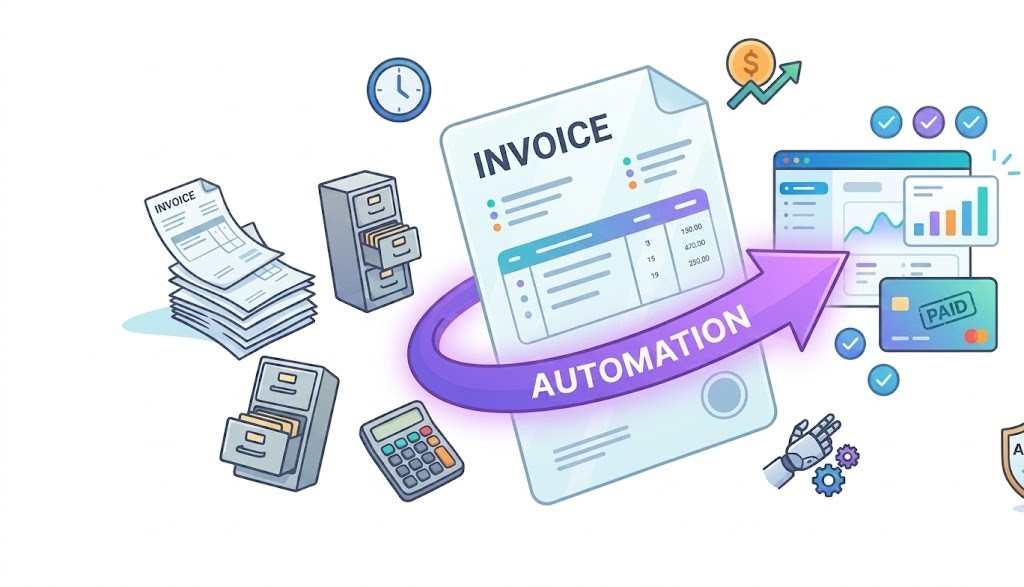
Accounts receivable automation now drives a measurable shift in how US enterprises convert revenue into cash. AR invoice automation eliminates the manual bottlenecks between invoice creation and payment reconciliation. It replaces reactive collections with structured, AI-driven workflows that CFOs can monitor in real time.
This guide covers AR automation meaning, implementation best practices, and the specific operational gains your finance team can capture in 2026. You will find side-by-side comparisons, actionable strategies for reducing DSO, and a clear framework for evaluating accounts receivable automation solutions built for enterprise scale.
Unlocking Value: How AR Invoice Automation Reduces Receivables Costs by 90%
AR invoice automation compresses the invoice-to-cash cycle from weeks to days. Organizations that deploy end-to-end accounts receivable automation report significant processing cost reductions by eliminating manual data entry, paper-based workflows, and ad hoc follow-ups. According to NetSuite’s AR automation guide, automated invoice generation and digital delivery compress processing timelines from days to seconds.
The measurable outcomes extend beyond cost. Automated AR systems shorten DSO within the first quarter of deployment. Cash application accuracy rises from typical manual match rates to above 95% with AI-driven reconciliation. These gains compound quarter over quarter as the system learns your customers’ payment behaviors.
Accounts Receivable in Modern Finance: Core Concepts for Your Cash Flow
Accounts receivable represents the total value of unpaid customer invoices your business expects to collect within agreed credit terms. The accounts receivable meaning in practice centers on working capital management. AR quality determines how predictable your cash inflows are and how much external financing you need.
Delayed collections, unresolved disputes, and inaccurate aging data erode liquidity. A $50M enterprise with an average DSO of 55 days ties up roughly $7.5M in receivables at any point. Reducing that DSO to 40 days releases over $2M back into operating cash flow. Your AR performance directly shapes your balance sheet health.
What Does AR Automation Mean? Core Principles and Value
AR automation meaning refers to the systematic use of software and AI to execute, monitor, and optimize receivables processes with minimal human intervention. This spans invoice generation, delivery tracking, collections orchestration, cash application, dispute management, and reporting. The distinction from billing automation is scope: AR invoice automation covers the full post-sale lifecycle from invoice presentment through payment reconciliation.
The core value proposition is control at scale. Automated AR creates a predictable operating model where every invoice follows the same workflow, every reminder fires on schedule, and every payment match follows consistent logic. Finance leaders gain audit-ready data and real-time decision support instead of spreadsheet-based guesswork.
How AR Invoice Automation Works in the Invoice-to-Cash Cycle
AR invoice automation orchestrates each step of the receivables cycle through integrated workflows and decision logic. The system generates invoices from ERP or CRM data, delivers them digitally via email or portal, and tracks open status in real time. It then triggers rule-based collection reminders, captures incoming payments, and matches them against open invoices automatically. Exceptions route to human reviewers with full context attached.
A mid-market manufacturer processing 5,000 invoices monthly illustrates the difference. Without automation, a clerk manually creates each invoice in the ERP, emails a PDF, logs follow-ups in a spreadsheet, and hand-matches payments from bank statements. With accounts receivable automation, the system pulls order data, generates and sends the invoice within minutes of shipment confirmation, escalates overdue accounts on day 7 and day 14, and auto-applies the majority of incoming payments. The remaining exceptions arrive in a prioritized queue with suggested matches. Platforms like Engini take this further with AI Workers that execute multi-step invoice-to-cash workflows across connected enterprise systems.
Business Impact: How Automated AR Strengthens Your Financial Operations
Automated AR transforms receivables from a cost center into a cash flow engine. Finance teams that deploy AR invoice automation at scale report three measurable outcomes: faster revenue conversion, lower operational costs, and stronger financial control.
- Cash flow acceleration: Automated invoice delivery and collections reduce average DSO significantly. Faster cash conversion reduces reliance on credit lines and improves borrowing terms.
- Error and dispute reduction: System-driven invoice generation eliminates data entry mistakes that cause payment delays. Fewer disputes mean fewer blocked payments and shorter resolution cycles.
- Stronger process control: Finance leaders gain real-time dashboards showing aging buckets, collector performance, and at-risk accounts. This visibility supports proactive intervention rather than month-end firefighting.
Unseen Costs and Risk: The Problem with Manual Accounts Receivable
- Hidden labor costs: Manual AR teams spend the majority of their time on repetitive tasks like invoice creation, follow-up emails, and payment matching. A four-person AR team processing 3,000 invoices monthly dedicates roughly 120 hours per month to tasks that automation handles in minutes.
- Revenue leakage through delayed collections: Without structured follow-up workflows, overdue invoices slip through cracks. Each day of delayed collection on a $500K receivable costs approximately $68 in financing charges at a 5% annual rate.
- Fragmented visibility: Data across spreadsheets and email threads prevents real-time visibility into aging receivables. Finance leaders cannot accurately forecast cash inflows when collection data lives in individual inboxes.
- Manual dispute tracking bottlenecks: Unresolved claims block payments for weeks when tracked manually. Without a centralized system, disputes pile up and drain analyst time.
- Compounding error rates: Manual data entry produces invoice errors in 1 to 3% of transactions. Each error triggers a dispute cycle averaging 15 to 30 days of payment delay.
Manual Processing vs. AR Invoice Automation: An In-Depth Comparison
The gap between manual and automated AR is not incremental. It is structural. Manual AR creates compounding inefficiencies as invoice volumes grow. AR invoice automation absorbs growth without proportional cost increases.
Process AreaManual Accounts ReceivableAR Invoice AutomationInvoice GenerationStaff manually creates invoices from order data, averaging 8 to 12 minutes per invoice with frequent data entry errors.Invoices auto-generate from ERP/CRM data in seconds with validated fields and accurate tax calculations.Collections Follow-UpAd hoc reminders depend on individual collector memory and effort. Missed follow-ups extend DSO by 5 to 15 days.Rule-based workflows trigger reminders at predefined intervals. Every overdue account receives consistent outreach.Cash ApplicationAnalysts manually match bank deposits to open invoices. Match rates average 60 to 80% with significant unapplied cash.AI-driven matching achieves 95%+ straight-through rates. Exceptions queue with suggested matches for rapid review.Error Rate1 to 3% of invoices contain errors requiring dispute resolution and rework cycles lasting 15 to 30 days.System validation reduces invoice errors to near zero. Disputes drop significantly.ScalabilityEach 20% volume increase requires additional headcount. Cost scales linearly with transaction growth.Platform handles 2x to 5x volume increases with the same team. Cost per invoice decreases as volume rises.Cash Flow ImpactAverage DSO of 45 to 60 days with limited ability to accelerate.DSO reduction within 90 days of deployment.
Key Advantages of AR Invoice Automation
AR invoice automation advantages span multiple operational dimensions. Each advantage compounds over time as the system accumulates payment behavior data and refines its matching and prioritization logic.
1. Faster Cash Conversion Cycles
Automated invoice delivery eliminates the 2 to 5 day lag between service completion and invoice receipt. Your customer sees the invoice the same day the order ships. Automated reminders at day 7, 14, and 21 maintain payment momentum without collector intervention.
2. Greater AR Team Productivity
Automation removes the bulk of repetitive tasks from your AR staff’s workload. Collectors focus on complex disputes and strategic accounts instead of chasing routine payments. A team of four can manage the same volume that previously required eight.
3. Real-Time Data and Visibility
Centralized dashboards display aging buckets, collector performance, and payment trends in real time. CFOs spot deteriorating accounts on day 3 instead of discovering them at month-end close.
4. Improved Cash Flow Forecasting
Accurate, up-to-date receivables data feeds directly into forecasting models. Automation reduces reliance on credit facilities by predicting inflows within 5% accuracy, compared to 15 to 20% variance under manual tracking.
12 Proven Best Practices for AR Invoice Automation Success
AR invoice automation best practices combine process standardization, phased rollout, and continuous measurement. These implementation steps build a scalable receivables function that delivers consistent outcomes across regions and business units.
1. Standardize Invoicing Methods and Channels
Define a single invoice template with mandatory fields: PO number, line item detail, payment terms, and remittance address. Standardize invoice formats across all entities and delivery channels. Route 100% of invoices through the automation platform rather than allowing some to go via manual email.
3. Establish Transparent Credit Policies for Customers
Establish clear customer credit policies with defined approval workflows, credit limits, and risk thresholds before onboarding. Automated credit scoring evaluates new customers against financial data and payment history in minutes instead of days. Consistent policies prevent revenue exposure to high-risk accounts.
4. Automate Collections Processes with Structured Workflows
Configure rule-based escalation paths with reminders at 3, 7, 14, and 30 days past due with customized templates per customer segment. Escalation triggers notify managers when accounts exceed defined thresholds.
5. Adopt AR Automation for Intelligent Cash Application
Deploy AI-driven payment matching for intelligent cash application. The system captures remittance data from checks, ACH, wire transfers, and lockbox files. AR automation meaning in this context is the automated reconciliation of payments to invoices at high accuracy, reducing unapplied cash backlogs.
6. Centralize AR Data for Company-Wide Reporting
Centralize accounts receivable data into a single platform to eliminate spreadsheet silos. A unified view improves reporting accuracy across business units. Finance leaders can compare aging and collection metrics by region, customer tier, or product line.
7. Integrate AR Automation with ERPs and Payment Platforms
Integrate AR with ERP systems like SAP, Oracle, or NetSuite and payment gateways to maintain bidirectional data flow. Native integrations eliminate manual exports and imports. Every invoice, payment, and adjustment syncs automatically between systems. Engini supports 1,000+ native integrations that connect AR workflows to your existing enterprise tools without custom development.
8. Focus on High-ROI AR Automation Areas First
Prioritize high-impact automation areas: cash application and collections deliver the fastest returns. Start there to build internal confidence and demonstrate ROI within 90 days. Expand to credit management, dispute resolution, and analytics in subsequent phases.
Essential Features in Top AR Invoice Automation Solutions
AR invoice automation solutions vary widely in capability depth. Enterprise-grade platforms combine AI-driven matching, multi-channel invoice delivery, and native ERP integration into a single system. The strongest solutions use machine learning models that improve payment matching accuracy over time by learning from your transaction patterns and customer behaviors.
Cloud-based AR invoice automation software provides the scalability that on-premise tools cannot match. Look for platforms that process invoices across multiple entities and currencies without requiring separate instances. The best solutions offer customer self-service portals where buyers view invoices, raise disputes, and make payments directly. This accelerates payment cycles and reduces inbound inquiries for your team.
- AI-powered cash application: Captures remittance data from multiple formats (EDI, lockbox, email, portal) and matches payments to open invoices automatically. Leading platforms achieve 95%+ straight-through processing rates.
- Predictive analytics and risk scoring: Machine learning identifies at-risk accounts before they become delinquent. Predictive models flag payment pattern changes and recommend proactive outreach strategies. Engini’s Finance Workers execute multi-step AR processes with context-aware decision-making and error recovery built in.
13 Quick Strategies to Lower Your Days Sales Outstanding (DSO)
These strategies deliver measurable improvements within 30 to 90 days of implementation:
- Send invoices the same day services are delivered or goods ship.
- Offer 2% early payment discounts for settlement within 10 days.
- Deploy automated reminders at 3, 7, and 14 days past due.
- Accept multiple payment methods: ACH, credit card, wire, and digital wallet.
- Segment customers by risk tier and assign collection strategies accordingly.
- Automate cash application to eliminate unapplied payment backlogs.
- Establish credit limits and review them quarterly based on payment history.
Recognized Leaders and Customer Success in AR Automation
Third-party analyst evaluations provide objective benchmarks for AR automation platform selection. Enterprise buyers should evaluate platforms based on analyst placement, deployment scale, and demonstrated customer outcomes.
Gartner Magic Quadrant for Invoice-to-Cash Applications
The Gartner Magic Quadrant evaluates vendors on their ability to execute against a stated vision for invoice-to-cash applications. Gartner AR automation leader status signals platform maturity, strong customer satisfaction, and a comprehensive feature set. Finance teams should review the latest Gartner report to compare vendor positioning relative to their own requirements.
The Hackett Group Digital World Class Vendor Recognition
The Hackett Group identifies vendors that meet Digital World Class standards for order-to-cash automation software. This designation reflects consistent performance across implementation quality and customer outcomes. It serves as a benchmark for enterprises evaluating vendor operational maturity.
IDC MarketScape for AR Automation Software
The IDC MarketScape evaluates AR automation vendors on integration of machine learning across their products. The report assesses payment matching, credit management, and cash forecasting capabilities for both large and midsized enterprises. IDC AR automation leader designations help buyers compare technical depth across platforms.
Forrester AR Invoice Automation Report
Forrester’s AR analysis evaluates vendors serving large enterprises in North America and EMEA. The report assesses how comprehensively each vendor meets complex enterprise receivables requirements. Review the latest Forrester landscape report to identify which platforms align with your operational scope.
When evaluating AR automation platforms, Engini differentiates through AI Workers that autonomously execute end-to-end receivables workflows with multi-step logic and error recovery. With 1,000+ native integrations, Engini connects directly to your ERP, CRM, and payment systems without custom development. Engini’s Finance Workers augment your team by handling invoice-to-cash processes with context-aware decision-making across connected enterprise systems.
Experience the Future of AR Automation: Next Steps
Your AR transformation starts with assessing your current state and mapping it against what automation can deliver.
Connect with a Finance Automation Specialist
Talk to an expert finance professional to identify the right automation fit for your receivables challenges.
View an On-Demand AR Automation Demo
Explore an on-demand demo finance automation walkthrough to see invoice-to-cash workflows in action.
Finance Automation Resources
- Credit Management and Risk Scoring Guides
- Invoice-to-Cash Workflow Documentation
- B2B Payments Integration Playbooks
- Order-to-Cash Analytics Frameworks
- Dispute Management Process Templates
- Collections Optimization Resources
AR Templates, Whitepapers & Case Studies
- Accounts Receivable Dashboard Template
- DSO Calculation and Benchmarking Template
- Accounts Receivable Aging Report Template
- Collection Email Templates with Escalation Sequences
- Credit Policy Sample for B2B Enterprises
- Strategies to Reduce DSO: Comprehensive Whitepaper
Final Thoughts: AR Invoice Automation as a Strategic Priority
AR invoice automation delivers measurable gains across every dimension of receivables management. From same-day invoice delivery to AI-driven payment matching, the technology compresses DSO, eliminates manual errors, and gives finance leaders real-time control over working capital. The future of AR automation belongs to organizations that treat receivables as a strategic function, not a back-office task.
Evaluate your current AR process against the benchmarks and best practices covered in this guide. Identify the highest-impact automation opportunity in your receivables workflow and build your business case for a phased deployment that proves value within 90 days. Book a Demo with Engini to see how Finance Workers execute end-to-end receivables workflows with context-aware decision-making and 1,000+ native integrations across your existing enterprise systems.
Frequently Asked Questions About AR Invoice Automation
Can accounts receivable be automated?
Yes. Modern AR platforms automate invoice generation, delivery, collections follow-up, cash application, and dispute tracking. Automation reduces DSO and cuts processing costs by replacing manual data entry and ad hoc follow-ups with structured, rule-based workflows.
What is AR automation?
AR automation uses software to generate digital invoices from financial system data, deliver them electronically, and match incoming payments to open invoices automatically. The system handles the full receivables lifecycle from invoice presentment through cash reconciliation without manual intervention.
Why should you use AR automation software?
AR automation software eliminates repetitive manual work across collections, invoicing, and payment matching. Your team sends accurate invoices faster, receives automated overdue alerts, and reconciles payments in real time. The result is shorter collection cycles and more time for high-value financial analysis.
How can AI-powered accounts receivable automation improve revenue operations?
AI-powered AR automation predicts customer payment behavior, prioritizes collection actions by risk score, and auto-matches payments across complex remittance formats. Revenue operations teams reduce DSO while maintaining positive customer relationships through timely, personalized communications.
What is accounts receivable automation?
Accounts receivable automation is the deployment of AI-driven software to manage invoicing, collections, cash application, and financial reporting across the invoice-to-cash cycle. It replaces spreadsheets and email-based tracking with automated workflows that deliver real-time accuracy and consistent execution.
How does AR automation improve cash flow?
AR automation accelerates invoice delivery to same-day dispatch, triggers automated payment reminders, and reconciles incoming payments within hours instead of days. Each step shortens the time between service delivery and cash receipt. Finance teams gain real-time visibility into outstanding balances and predicted inflows.
What are the benefits of accounts receivable automation?
Core benefits include DSO reduction, lower processing costs, high cash application accuracy, real-time aging visibility, and fewer invoice disputes. These gains strengthen working capital position and free finance staff for strategic planning.