Beyond the Bot: Why Your Quote-to-Cash Needs an Orchestration Layer in 2026
The manual gap between Salesforce and NetSuite is costing you more than just time, it’s creating "Agentic Drift." Discover why 2026’s top Finance Ops teams are moving beyond basic bots to an Orchestration Layer that automates the entire Quote-to-Cash lifecycle with zero data friction.
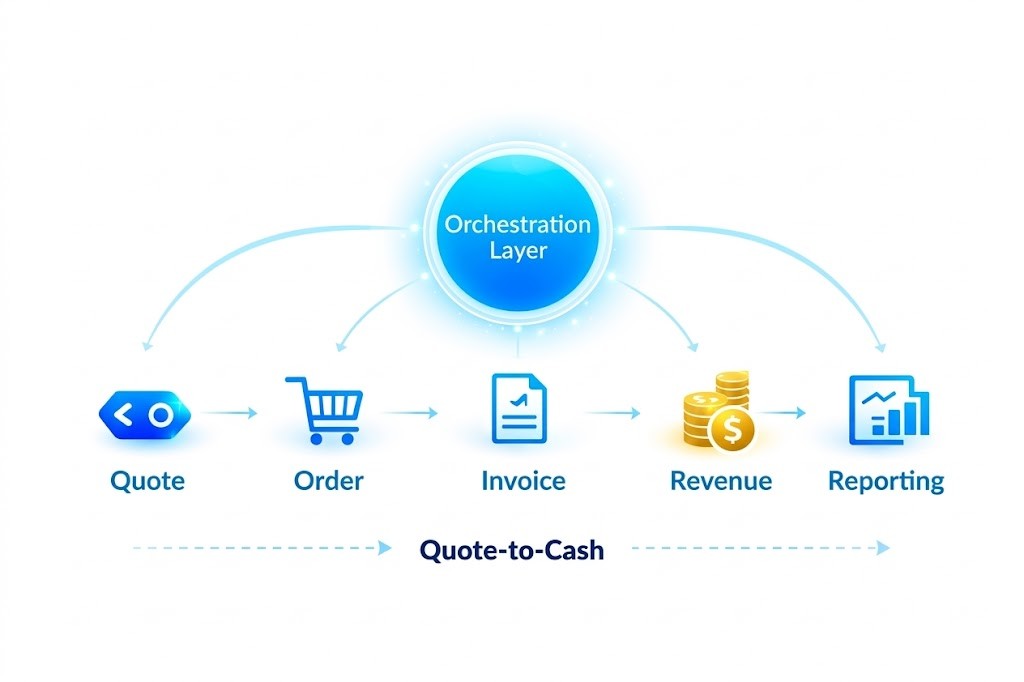
Automating Salesforce to NetSuite Quote-to-Cash (Q2C) removes the manual data-entry friction that leads to billing errors, delayed revenue recognition, and fragmented audit trails. Instead of relying on RevOps teams to manually bridge the gap between "Closed Won" opportunities and financial records, modern organizations deploy Agentic Workflows to sync Sales and Finance systems in real-time.
The transition from a signed contract in Salesforce to an active invoice in NetSuite is often the most fragile part of the revenue lifecycle. Without a dedicated orchestration layer, companies face "Agentic Drift"—where AI sales agents move faster than the rigid financial guardrails of an ERP can handle. This technical blueprint outlines how to build a scalable, automated Q2C pipeline using Engini’s Orchestration Layer.
Why Automate Salesforce to NetSuite Q2C?
Manual Quote-to-Cash processes create a "revenue lag" that impacts cash flow and distorts financial reporting accuracy. Modern teams are moving away from seat-based manual entry to maximize their Revenue per Human and AI ROI.
- Manual "Sync" errors lead to invoice disputes
- Fragmented data slows down the monthly close
- Lack of real-time tax and compliance validation
- High DSO (Days Sales Outstanding) due to billing delays
- Limited visibility into the full customer lifecycle
Automating this flow ensures that Finance Ops can operate with the same speed and agility as the Sales team, powered by Engini for Finance Ops.
Salesforce to NetSuite Q2C Architecture Overview
A high-performance Q2C integration doesn't just "push" data; it orchestrates it. It acts as a bidirectional translator between the fluid nature of CRM objects and the strict ledger requirements of an ERP.
The Q2C Pipeline Stages:
- Trigger: Opportunity marked "Closed Won" in Salesforce.
- Validation: Engini AI verifies contract terms and SKU mapping via Custom Connectors.
- Transformation: Salesforce data schema is mapped to NetSuite Sales Order structure.
- Ingestion: NetSuite generates the Sales Order and Invoice.
- Loopback: Transaction ID and Invoice status synced back to Salesforce for sales visibility.
Challenges of Manual Quote-to-Cash Workflows
| Challenge | Impact | Orchestration Solution |
|---|---|---|
| "Seat-Based" Data Entry | Human error during manual SKU mapping | Automated SKU validation & mapping via Engini Workflows |
| Contract-Ledger Drift | Discrepancies between what was sold and what was billed | Continuous sync across the transaction lifecycle |
| Multi-Currency Friction | Manual exchange rate calculations lead to errors | Real-time currency & tax orchestration |
| Tax Compliance Gaps | Audit risk due to missing or incorrect tax codes | Automated compliance validation in-flight |
| Delayed Revenue Recognition | Inability to report accurate NRR/ARR in real-time | Instant ledger posting upon deal closure |
Methods to Automate Salesforce to NetSuite
| Method | Scalability | Agility | Best Use Case |
|---|---|---|---|
| Legacy iPaaS | Medium | Low | Static, low-volume SMBs |
| Point-to-Point API | Low | Medium | Simple, single-product startups |
| Agentic Orchestration (Engini) | Very High | Very High | Scaling SaaS with complex pricing & logic |
The Best Workflow for Q2C Automation
Modern Finance Ops replaces rigid "Batch" processing with event-driven logic designed specifically for RevOps and Finance roles.
- Salesforce Listener detects deal closure and extracts contract metadata.
- Orchestration Layer runs a "Logic Check" (Does the SKU match the region? Is the discount approved?).
- Schema Converter translates the Opportunity into a NetSuite-ready Sales Order.
- Financial Ingestion posts the entry directly to the General Ledger via the Engini NetSuite Integration.
- Success Confirmation updates the Salesforce account record with the Invoice link.
Does Salesforce Integrate Directly with NetSuite?
While basic connectors exist, Salesforce and NetSuite operate on radically different data structures. Native connectors often fail when companies introduce complex discounting, multi-subsidiary billing, or usage-based pricing models. Most scaling organizations require an orchestration layer to manage the "Business Logic" that sits between the CRM and the ERP.
Engini’s Approach to Quote-to-Cash Orchestration
Engini provides a persistent, intelligent layer that ensures your Sales engine never outpaces your Finance guardrails using Agentic Workflow Orchestration.
- Real-time contract-to-invoice validation
- Automated SKU and Tax mapping pipelines
- Bidirectional sync between Salesforce and NetSuite
- Audit-grade logging for every transaction step
- Adaptive logic for usage-based and tiered pricing
Instead of manual reconciliation, Engini ensures your "System of Record" becomes a true driver of growth.
Conclusion: Scaling the Sales Engine without Breaking Finance
As B2B spend flows toward AI agents and automated workflows, the "Seat-Based" model of manual data entry is no longer viable. Implementing a real-time Salesforce to NetSuite Q2C infrastructure is the only way to protect NRR and ensure scalable growth.
By moving from manual syncs to agentic orchestration, Finance Ops teams can eliminate friction, accelerate cash collection, and focus on strategic growth. See how your current stack stacks up with our AI ROI Calculator.
Frequently Asked Questions (FAQ)
How do I sync Salesforce Opportunities to NetSuite Sales Orders?
The most effective way is using an orchestration layer like Engini that captures "Closed Won" triggers in Salesforce and automatically maps the metadata into NetSuite's schema using specialized Connectors.
What is Agentic Drift in Quote-to-Cash?
Agentic Drift occurs when automated sales agents move faster than your manual back-office processes, leading to data mismatches and unbilled revenue.
Can Engini handle multi-currency Salesforce deals?
Yes. Engini's orchestration layer can validate and convert currencies in real-time before posting the final transaction to the NetSuite ledger via our Finance-specific workflows.
Why is manual Q2C a risk for SaaS companies?
Manual processes lead to high error rates in SKU mapping, delayed invoicing, and "Revenue Leakage" that can impact valuation and audit readiness.