Challenges Deploying Autonomous Workflows at Enterprise Scale (Architecture, Risks, and Solutions)
Deploying autonomous workflows at enterprise scale introduces integration, governance, reliability, and security challenges. Learn the architecture patterns organizations use to deploy workflow autonomy safely.
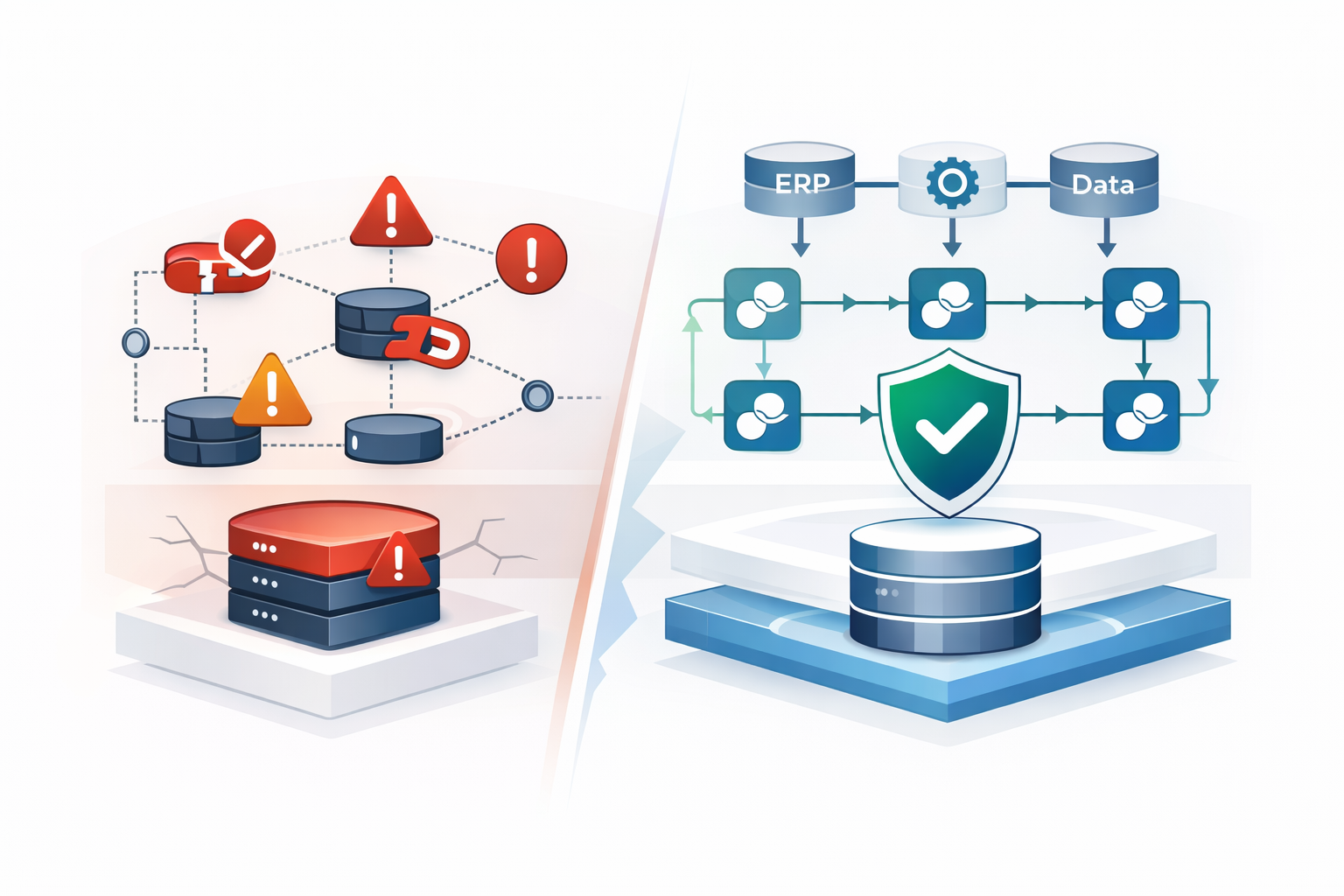
Deploying autonomous workflows at enterprise scale introduces infrastructure coordination challenges that traditional automation stacks are not designed to handle. While pilot workflows succeed quickly, production deployments require governance visibility, permission-scoped execution policies, monitoring infrastructure, and agent orchestration infrastructure capable of coordinating enterprise AI agents safely across environments.
Organizations adopting Agentic Workflow Orchestration often discover autonomy increases execution speed faster than compliance and observability layers can adapt. This guide explains the real challenges deploying autonomous workflows at enterprise scale and the architecture patterns leading teams use to solve them.
What are the challenges deploying autonomous workflows at enterprise scale?
Challenges deploying autonomous workflows at enterprise scale typically include legacy system integration complexity, governance visibility requirements, security boundary enforcement, reliability safeguards, observability gaps, organizational trust barriers, and the need for structured autonomous decision execution layers.
These challenges emerge when automation expands beyond pilots into production infrastructure coordinated by enterprise AI agents operating across multiple environments.
Why autonomous workflow pilots succeed but enterprise deployments stall
Pilot workflows operate inside isolated execution environments. Enterprise deployments must coordinate systems, APIs, approval layers, and monitoring infrastructure simultaneously.
Without workflow orchestration infrastructure designed for enterprise deployment, autonomous execution introduces monitoring blind spots, integration fragility, and governance uncertainty across environments.
Enterprise autonomous workflow deployment challenges and solutions
| Challenge | Risk Introduced | Enterprise Solution |
|---|---|---|
| Legacy integration complexity | Deployment delays across infrastructure environments | Standardized routing via orchestration middleware |
| Governance visibility gaps | Compliance exposure and audit uncertainty | Approval-aware execution checkpoints |
| Security boundary enforcement | Uncontrolled tool execution risk | Permission-scoped agent execution policies |
| Reliability instability | Dynamic workflow failure conditions | Fallback-enabled execution logic |
| Organizational trust barriers | Slow adoption across teams | Transparency dashboards and phased rollout |
| Monitoring blind spots | Execution opacity across environments | Observability infrastructure layers |
Key enterprise risks when scaling autonomous workflows
- Uncontrolled execution across infrastructure environments
- Missing workflow audit trails
- Security boundary violations between systems
- Legacy API coordination fragility
- Limited workflow observability coverage
- Over-automation without escalation checkpoints
Pilot automation vs enterprise autonomous workflow deployment
| Pilot Workflows | Enterprise Autonomous Workflows |
|---|---|
| Single-system execution | Cross-environment orchestration |
| Minimal governance | Enterprise AI governance enforcement |
| Limited monitoring | Observability infrastructure layers |
| Static execution logic | Supervisor-agent coordination models |
| Manual oversight | Human-in-the-loop automation checkpoints |
Architecture patterns that successfully scale autonomous workflows
Organizations deploying enterprise workflow autonomy successfully rely on structured orchestration layers coordinating execution behavior across systems.
- Supervisor-agent workflow coordination
- Tiered autonomy execution strategies
- Fallback-enabled execution routing
- Governance-aware orchestration infrastructure
- Multi-system automation architecture layers
Enterprise architecture requirements for autonomous workflow deployment
Enterprise autonomous workflow deployment requires orchestration infrastructure capable of coordinating execution across systems while maintaining governance visibility, approval checkpoints, and permission-scoped agent behavior across environments.
Organizations implementing production-grade workflow autonomy typically introduce monitoring layers, structured execution routing logic, and escalation-aware automation checkpoints aligned with role-based enterprise deployment strategies.
How enterprises deploy autonomous workflows safely
Enterprises successfully deploy autonomous workflows by introducing monitoring infrastructure, enforcing permission-scoped execution policies, implementing approval-aware workflow checkpoints, and coordinating execution through persistent orchestration layers like Engini Agentic Workflows.
Deploy autonomous workflows safely across enterprise systems
Scaling automation beyond pilots requires infrastructure designed specifically for governance visibility, reliability enforcement, and secure execution coordination across environments.
Explore how organizations deploy production-grade autonomy using Engini integrations and orchestration infrastructure.
Frequently Asked Questions (FAQ)
What are autonomous workflows in enterprise AI?
Autonomous workflows coordinate tools, APIs, and infrastructure environments automatically using enterprise AI agents operating inside governance-aware orchestration infrastructure.
Why is deploying autonomous workflows difficult at enterprise scale?
Enterprise deployment requires workflows to integrate with legacy systems, maintain auditability, respect security boundaries, and operate reliably across multiple infrastructure environments.
Are autonomous workflows safe for regulated industries?
Yes. Organizations deploy permission-scoped execution layers and approval checkpoints that allow autonomous workflows to operate safely inside compliance-sensitive environments.
What architecture supports enterprise workflow autonomy?
Supervisor-agent coordination combined with workflow orchestration infrastructure and human-in-the-loop automation checkpoints enables safe enterprise-scale deployment.