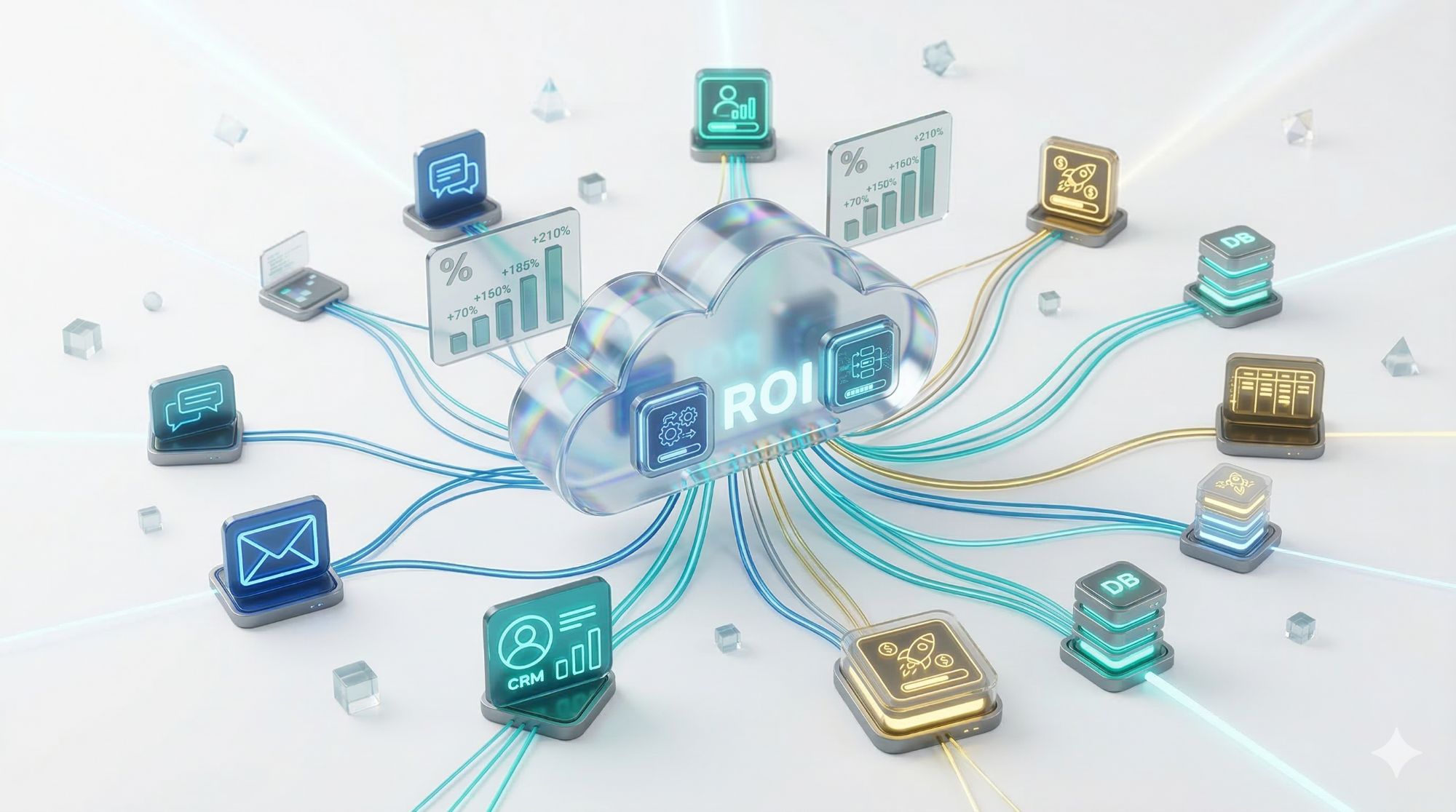
What is cloud integration? Cloud integration is the technical process of connecting various cloud-based applications, databases, and on-premises systems so they function as a single, unified ecosystem. This process automatically syncs data and workflows across platforms, eliminating manual data entry and ensuring real-time operational accuracy for businesses in 2025.
In today's business landscape, companies increasingly rely on a massive number of cloud applications. While these SaaS tools offer outstanding flexibility, they often operate in total isolation. That isolation creates severe challenges with data flow, operational efficiency, and organizational clarity.
Why Cloud Integration Matters
Without proper integration, businesses constantly struggle with operational inefficiencies and missed revenue opportunities. The most immediate threat is the creation of Data Silos, where valuable information becomes trapped within disconnected systems. This forces employees to spend hours manually transferring data, which destroys productivity and introduces human error.
Effective cloud integration solves this by offering four distinct benefits:
- Streamlined Operations: Automated workflows reduce redundancies and eliminate human data-entry errors.
- Uncompromised Data Accuracy: Real-time syncing ensures your information is consistent and reliable across every department.
- Infinite Scalability: Integrated systems adapt and grow much faster as your business operations expand.
- Enhanced Agility: Your engineering teams can deploy new services and technologies without breaking existing workflows.
The 4 Core Types of Cloud Integration
Choosing the right architecture depends entirely on your current infrastructure and business goals. This decision is central to your broader agentic orchestration strategy.
- Data Integration: This approach connects and orchestrates raw data across multiple databases. It ensures that business intelligence tools and users can access consistent, up-to-date information from any platform at any time.
- Application Integration: This method enables different software applications to communicate with each other. It allows systems to trigger specific automated workflows based on real-time conditions or events.
- Process Integration: Goes a step further by connecting and orchestrating complex business processes across multiple platforms. This improves operational efficiency by managing the entire lifecycle of a task.
- Hybrid Integration: Securely bridges modern cloud applications with older, on-premises Legacy Systems. This enables large organizations to modernize without having to fully migrate all infrastructure at once.
Key Cloud Integration Platforms (iPaaS) Compared
Choosing the right Integration Platform as a Service (iPaaS) depends on your technical expertise and budget.
Common Use Cases by Industry
Cloud integration is applicable across every industry and business size. Many organizations utilize specialized AI Workers to manage these cross-platform tasks:
- E-commerce: Integrating storefronts with inventory systems and support tools.
- Healthcare: Syncing electronic health records (EHR) with lab systems, scheduling tools, and telehealth platforms.
- Financial Services: Linking CRM systems with accounting and compliance tools to automate onboarding and audit reports.
- Education: Integrating LMS platforms, student information systems (SIS), and communication tools.
- Human Resources: Integrating HRIS systems with payroll and recruitment software for employee lifecycle management.
- Marketing and Sales: Connecting HubSpot, Salesforce, and Google Ads for lead scoring and faster conversions.
- Manufacturing: Syncing ERP systems with supply chain management and quality control tools.
- Logistics: Integration between route optimization, fleet tracking, and CRM platforms for efficient shipment management.
Expert Insight: Best Practices for Success
From the Engini Engineering Team: A successful cloud integration requires more than just a software license; it requires strict technical discipline. We recommend five core principles: Start with clear objectives, choose the right iPaaS platform, standardize data formats across your stack, prioritize security and compliance from day one, and monitor performance continuously to spot API rate limits early. Utilizing secure connectors is essential for maintaining this discipline.
The Challenges of Cloud Integration
Despite the benefits, connecting an ecosystem comes with technical hurdles:
- Data Security and Privacy: Sensitive information moving between clouds must be protected with strong encryption and access controls.
- Managing API Limitations: Maintaining performance when third-party vendors update their APIs or enforce rate limits.
- Ensuring Real-Time Performance: Syncing massive datasets or time-sensitive processes demands robust infrastructure (often powered by Webhooks).
- Handling Vendor Lock-in: Relying too heavily on a single proprietary provider can limit flexibility and increase long-term costs.
- Technical Debt: Older systems may not support modern integration frameworks, complicating the cloud transition.
Conclusion
Cloud integration is no longer a luxury; it is a strategic imperative for any organization aiming to stay competitive in 2025. By breaking down silos and enabling automation, integration unlocks massive efficiency and fuels innovation. Ready to unify your digital ecosystem? Onboard your first Engini AI Worker today and connect your tools faster.
Frequently Asked Questions (FAQ)
1. What is the main purpose of cloud integration?
To connect disparate software applications, databases, and IT environments so they share data in real-time, preventing silos and manual entry.
2. What is the difference between iPaaS and native integrations?
Native integrations are pre-built by a specific software vendor. An iPaaS is a third-party platform that allows you to build custom, complex workflows between hundreds of different tools.
3. Is cloud integration secure?
Yes, but it requires intentional configuration, including encrypting data at rest and in transit, and using secure authentication like OAuth or SAML.
Frequently Asked Questions
What is cloud integration and why do enterprise organizations need it?
Cloud integration is the technical discipline of connecting cloud-based applications, databases, and on-premises systems so they function as a coordinated ecosystem rather than isolated silos. Enterprises need it because modern operations depend on data flowing accurately between CRM, ERP, HRIS, billing, and customer platforms. Without integration, teams re-enter data manually, reports contain contradictory figures from different systems, and process automation breaks at every system boundary.
What is the difference between cloud integration and traditional enterprise middleware?
Traditional enterprise middleware such as IBM MQ or Oracle SOA Suite was designed for on-premises architectures, requiring dedicated hardware, specialist configuration, and significant upfront investment. Cloud integration platforms are API-first and subscription-based, designed for the SaaS connectivity patterns that define modern tech stacks. They handle OAuth 2.0 authentication, rate limiting, and webhook delivery natively, whereas traditional middleware required custom adapters for each modern SaaS API.
How do you choose the right cloud integration platform for a complex enterprise tech stack?
The selection criteria that matter most at enterprise scale are: the breadth of native connectors for your specific systems (SAP, Salesforce, NetSuite, Workday), support for complex transformation logic beyond field mapping, data validation before writes to prevent silent corruption, a complete audit trail for compliance, and pricing that remains predictable at your transaction volumes. Evaluate platforms against your actual integration use cases rather than connector counts alone.
Itay Guttman
Co-founder & CEO at Engini.io
With 11 years in SaaS, I've built MillionVerifier and SAAS First. Passionate about SaaS, data, and AI. Let's connect if you share the same drive for success!