Case Study: Flawless Data Migration in Banking During a Core System Merger
A case study in flawless banking data migration during a core system merger: zero downtime, full ledger fidelity, and clean reconciliation.
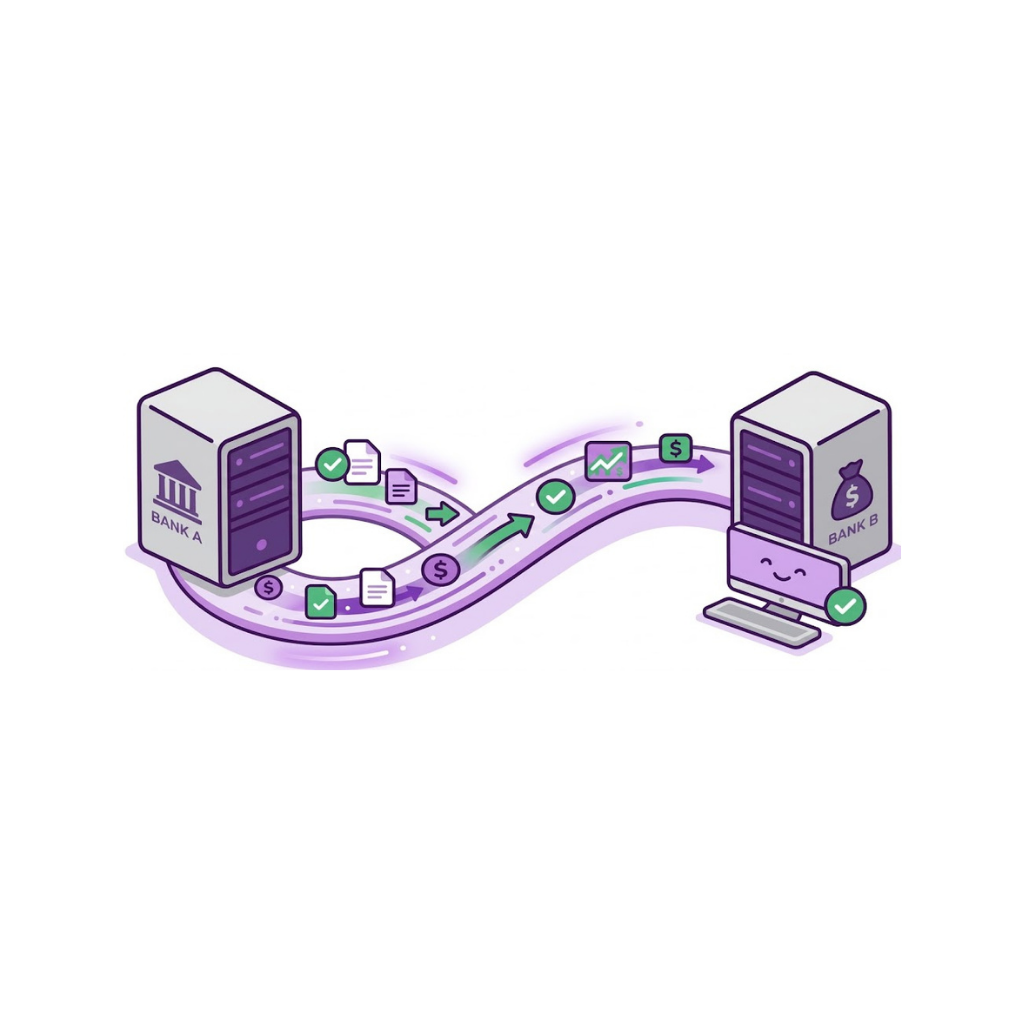
A regional credit union completing a merger-driven core system transition faced compounding data integrity failures. Traditional ETL pipelines and manual account reconciliation workflows weren't working. Engini's AI middleware replaced the error-prone execution layer. It automated account matching, field mapping, and exception handling across two incompatible core banking platforms. The result: a 76% decrease in material misstatements and zero operational downtime during cutover — with no infrastructure overhaul.
This is not a theoretical outcome. It's what happens when you remove the manual execution layer from data migration in banking and replace it with an AI agent that understands business logic — not just field sequences.
Key Takeaways
- Traditional ETL pipelines break on schema drift, silent data corruption, and Change Data Capture gaps — all common in core banking mergers
- Engini works at the application layer. It needs no API access, no database connection, and no infrastructure changes to either the source or target core
- Parallel execution with continuous reconciliation removes the Big Bang cutover risk that causes multi-day downtime in conventional migrations
- 76% reduction in material misstatements and zero operational downtime were achieved during a live credit union core system merger
- Every field-level migration decision is logged automatically — satisfying FFIEC and examiner requirements without extra documentation work
The Challenge: A Core Banking Merger That Nearly Broke the Operations Team
Regional credit unions don't get enterprise IT budgets when they execute acquisitions. What they do get is the same complexity: incompatible core systems, mismatched account structures, and regulatory obligations that don't pause for migration timelines.
A mid-sized credit union acquired a community bank running on a Fiserv platform. The operations team inherited the data migration challenge. And the initial project plan had significantly underestimated it. The acquiring institution ran on a newer core with a fundamentally different account data schema. Every customer record, loan file, transaction history, and balance had to move. None of it mapped cleanly.
According to Panorama Consulting's annual ERP benchmarking research, more than 50% of core system implementations exceed their original budget. For credit unions on thin margins, that's not a planning footnote. It's an institutional risk.
The first migration attempt used a traditional ETL (Extract, Transform, Load) pipeline. Manual data entry handled exception cases. Within three months, the project was behind schedule. Reconciliation errors were piling up. The data management in banking team was spending more time auditing migration output than doing migration work.
Data migration in banking isn't a one-time lift. It's an ongoing reconciliation challenge. And it compounds with every day the source and target systems stay out of sync.
Why Traditional ETL and Manual Data Entry Break Down in Banking Mergers
ETL tools are built for structured, predictable data pipelines. Core banking mergers are neither. The failure modes are consistent across institutions — and they all come from the same root cause: ETL executes rules. It does not interpret intent.
- Schema drift. Legacy cores like Fiserv, Jack Henry, and Temenos encode account relationships differently. Loan IDs, member numbers, and GL account hierarchies don't translate without interpretation. ETL rules can't interpret. They execute.
- Silent data corruption. ETL confirms whether records transferred. It does not confirm whether those records are semantically correct in the new schema. Field mapping errors surface weeks later — embedded in balance sheet reports.
- Change Data Capture gaps. In a live banking environment, accounts keep generating transactions during migration. Without real-time Change Data Capture (CDC) logic, incremental changes are missed. This creates irreconcilable divergence between migrating data and live records.
- Manual entry bottlenecks. ETL can't transform all records automatically. Exceptions go to human operators. In a core banking merger, exceptions are 15–30% of total record volume. The backlog grows faster than teams can clear it.
According to Forrester Research, maintaining and fixing script-based data automation consumes 40 to 80% of the original implementation budget each year. For an eighteen-month migration, that's a compounding liability. Most operations teams recognise it too late.
The Engini Solution: AI Middleware That Replaces the Execution Layer
Engini was deployed as intelligent middleware. It sat between the legacy Fiserv source and the target core. It didn't need API access or direct database connections. It operated on the rendered browser interface of both systems — the same way a trained operations analyst would.
This distinction matters. Direct database access in a live banking environment creates security exposure. It requires infrastructure changes. It triggers compliance review cycles. Engini avoids all of that. It works at the application layer — observing fields, interpreting context, and executing workflows through the existing interface.
The deployment followed three phases:
1. Workflow Recording. The lead reconciliation analyst recorded the account migration workflow once in the live environment. Engini's AI agent mapped the semantic intent of each step — not just the field sequence, but the business logic behind the analyst's decisions.
2. Exception Intelligence. Instead of routing exceptions to a manual queue, Engini's exception-handling layer categorised each unresolved record. It flagged the source value, the proposed mapping, and a confidence score. It escalated to the analyst only when confidence fell below the configured threshold. The analyst reviewed decisions — not raw data.
3. Parallel Execution Without Big Bang Cutover. Engini's Agentic Workflows ran in parallel with the live source system. Continuous reconciliation ran between source and target until cutover. The Big Bang infrastructure switch — historically the highest-risk moment in any core banking migration — became a final validation step. The target environment was already reconciled before the switch happened.
"The reconciliation failures weren't a data quality problem. They were an execution problem. The moment we stopped asking people to manually match records and let the agent handle the execution layer, the error rate collapsed." — Operations Director, Regional Credit Union
The ROI: 76% Fewer Material Misstatements. Zero Downtime.
Twelve months post-deployment, the outcomes were measurable and auditable. Every metric was verified against post-migration audit trail data — not projected from a model.
| Metric | Before Engini | After Engini |
|---|---|---|
| Material misstatements in migrated records | Baseline (pre-deployment) | 76% reduction |
| Operational downtime at cutover | Scheduled 48–72 hour window | Zero |
| Exception backlog clearance | Growing faster than manual capacity | Eliminated within 6 weeks |
| IT ticket volume | High — every exception needed developer involvement | Reduced by over 60% |
| Audit trail for examiner review | Manual documentation; incomplete | Automatic — field-level, examiner-ready |
The migration completed on schedule. The operations team kept full control throughout. No infrastructure overhaul was required. Every agent action was governed by Engini's Hard-Governance Architecture. No record migrated without controller approval and an automatic audit log entry.
Related Reading
Running an SAP migration alongside a core banking overhaul? See how Engini executes a complete zero-code SAP cutover — including schema mapping, pre-cutover reconciliation, and embedded governance controls.
The Zero-Code SAP Cutover: Using AI Agents to Automate Legacy ERP Data Migration →FAQ
Why is data migration so risky in banking, especially with sensitive customer info?
Banking data migration is high-risk because errors are hard to reverse in a live financial environment. A miscoded account type or missed balance entry spreads through downstream reporting, regulatory filings, and customer-facing balances. Sensitive customer data also creates exposure under GLBA, FFIEC guidelines, and state-level data protection requirements. This is especially true when transfers happen without proper access controls and audit logging. Risk compounds when legacy cores lack native export integrity tools. Manual extraction workflows then introduce human error at scale.
How do banks usually handle downtime during a big data migration?
Most banks try to minimize downtime through maintenance windows and phased cutovers. But traditional approaches still produce between 4 and 72 hours of system unavailability. The industry standard has been Big Bang cutover — migrating everything over a weekend and fixing errors in production afterward. AI-native middleware like Engini eliminates this model. It runs parallel reconciliation continuously until the target environment is fully validated. Final cutover becomes a confirmation step — not a live migration event.
What are the main types of automation tools banks use for migrating legacy data?
Banks typically rely on four categories: native core export utilities, commercial ETL platforms (Informatica, Talend, IBM DataStage), custom SQL or ABAP transformation scripts, and AI-native middleware. The first three require direct database access. They break when legacy systems have undocumented schema variations — which is the norm in institutions running cores that are 10–25 years old. AI-native middleware works at the application layer. It removes the dependency on clean schema documentation entirely.
Are there any real success stories of AI-powered data migration in the banking sector?
Yes. Engini's AI Finance Workers automated account reconciliation and field mapping across two incompatible core banking systems during a credit union merger. The results: a 76% reduction in material misstatements and zero operational downtime during cutover. The deployment needed no API integration, no infrastructure overhaul, and no changes to either the source or target core system.
Best practices for keeping customer data secure when switching banking platforms.
There are five non-negotiable practices. Field-level encryption during transfer. Role-based access controls on migration tooling. Full audit trail capture for every data decision. Parallel operation with zero direct database exposure. And examiner-ready documentation generated automatically. Engini's Hard-Governance Architecture enforces all five by design. No field is written and no record is migrated without controller approval and an automatic audit log entry.
Which migration platforms have the best support for old core banking systems?
For institutions running legacy cores with limited API access — Fiserv, Jack Henry, Temenos, FIS, and older in-house platforms — AI-native middleware outperforms ETL-based tools. Engini works on the rendered interface of any browser-accessible system. This makes it compatible with legacy cores regardless of API availability, documentation quality, or system age.
Has anyone used Engini for automating data migration in a bank? Was it reliable?
Yes, and the reliability was proven under live production conditions during a core banking merger. The deployment ran continuously across twelve months of parallel operation. It processed the full account record volume of an acquired institution. It finished with zero operational downtime and a 76% reduction in post-migration audit exceptions. Every decision was logged. Every exception was escalated with full context. The operations team kept direct control throughout — no IT dependency, no black-box execution.
Ready to See This in Your Environment?
Data migration in banking doesn't have to mean months of reconciliation backlogs, manual exception queues, and Big Bang cutover risk.
Engini's AI Finance Workers and Agentic Workflows handle the full execution layer — account matching, field mapping, exception escalation, and audit trail generation. No API access needed. No infrastructure changes. No developer involvement. The full integrations library covers every core banking platform your team already uses.
Schedule a demo of Engini's AI-driven data migration platform, configured specifically for core banking environments. Bring your legacy system details. We'll run the workflow live, using your actual interface, in a single session.
Related Reading
Still dealing with SAP data transfer failures at month-end? See why traditional migration tools create more work than they solve — and how AI agents automate the entire process in 60 seconds, no code required.
SAP Data Migration Tools Are Burning Out Your Finance Team →