How Engini AI Replaced a 12-Month MuleSoft Roadmap with a 30-Day Agentic Bridge
Enterprise integration projects on legacy platforms routinely stretch 12-18 months before a single workflow reaches production. Engini AI compresses that to 30 days with an agentic bridge that connects FIS, Jack Henry, SAP and 1,000+ systems—no vCore pricing, no proprietary lock-in, no 12-month roadmap.
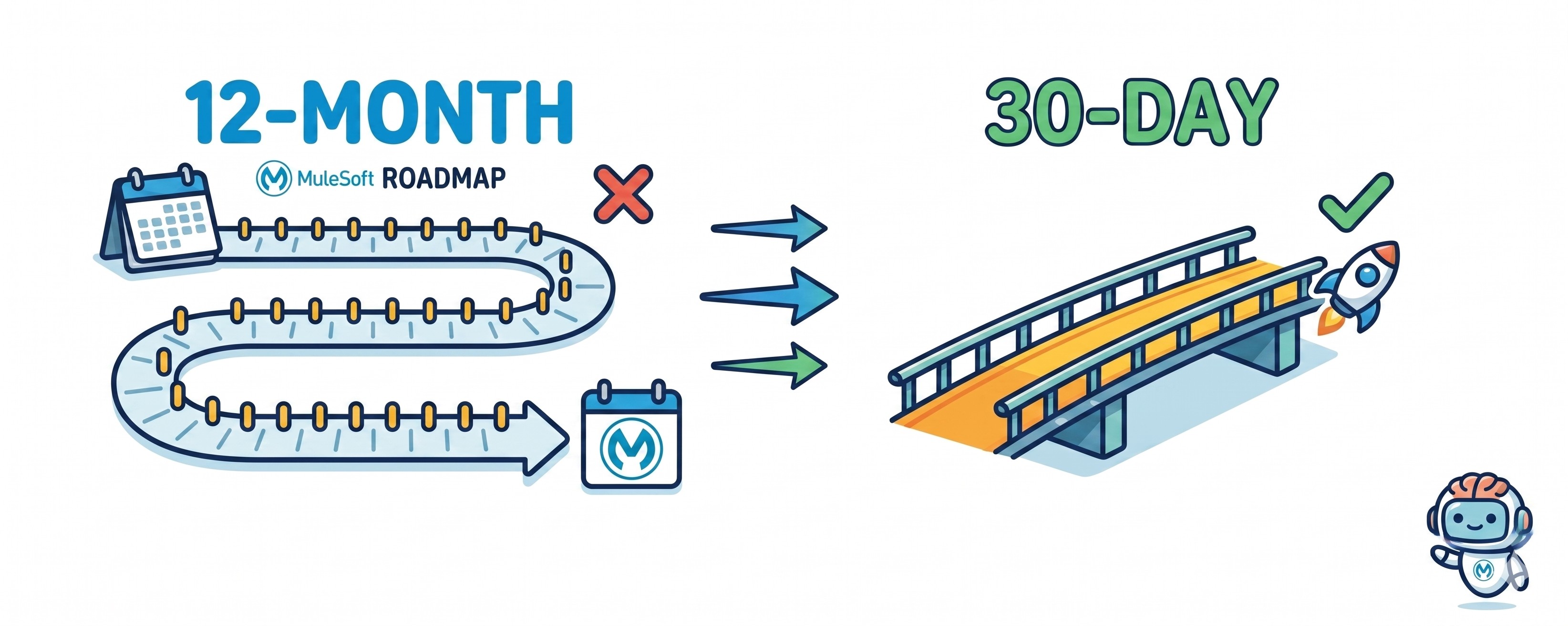
Enterprise integration projects built on legacy platforms routinely stretch 12 to 18 months before a single workflow reaches production. Engini AI compressed that timeline to 30 days. It does this by deploying an agentic bridge that connects systems, enforces business logic, and executes workflows through AI-powered Workers.
These Workers operate across core business systems like FIS, Jack Henry, and SAP. They connect to 1,000+ native integrations and use context-aware decision-making. The result is a significant drop in integration TCO and a faster path to 2026 business outcomes.
According to the 2026 Connectivity Benchmark Report, 88% of organizations are advancing toward significant or full agentic transformation. Engini AI sits at the center of this shift. The platform delivers enterprise automation through AI-native autonomous workflows. These bypass the cost spirals, talent bottlenecks, and DevOps gaps that define legacy MuleSoft deployments. For decision-makers evaluating a hyperautomation alternative, the contrast between a year-long roadmap and a 30-day agentic bridge represents a generational leap in AI integration speed.
Enterprise Drivers for Transitioning from MuleSoft to Agentic Automation
Enterprise leaders face a convergence of pain points with legacy integration platforms. MuleSoft’s vCore pricing model compounds costs as integration volume grows. DataWeave’s proprietary transformation logic locks organizations into a shrinking talent pool. CI/CD pipelines demand months of custom scripting. The platform offers zero native capability for autonomous business process orchestration. Each of these pain points accelerates the search for a modern agentic AI platform that delivers enterprise automation without structural trade-offs.
Agentic bridges solve these problems by design. They replace proprietary transformation logic with AI-native orchestration. The system reads enterprise context, applies policy, and executes multi-step workflows across connected systems. Engini AI deploys Workers that augment human teams with context-aware automation. These Workers handle repetitive, policy-driven workflows. Humans retain oversight and strategic control throughout.
TL;DR – The Critical Shift in Enterprise Integration
- MuleSoft cost spirals through vCore pricing and environment licensing multiplication.
- DataWeave lock-in creates single-vendor developer dependency with escalating exit costs.
- Enterprise AI demands autonomous orchestration across any connected system—not Salesforce-only Einstein integrations.
- An AI automation platform with agentic architecture delivers production-ready capability in days, not quarters.
A 2026 Perspective on MuleSoft’s Market Position
MuleSoft built its reputation on strong connectivity and API management. For a decade, it served as the default answer when enterprises needed to connect SAP, Salesforce, and legacy ERP systems. Cloud-native integration platforms now deliver equivalent connectivity without proprietary runtime dependencies. AI-native automation tools embed reasoning directly into workflow execution.
According to MuleSoft’s own communications, AI is becoming part of how every system operates. The growing number of agentic AI training programs reflects rising enterprise demand for agent-based architecture. The API management evolution has moved past static patterns toward intelligent orchestration layers that coordinate multiple AI agents across enterprise systems.
- 6 to 18 months: typical MuleSoft deployment timeline based on industry reports
- $0 public pricing published on mulesoft.com — every engagement requires a custom quote
- Cloud-native integration competitors now ship native Git support, per-automation pricing, and production AI agents
Pitfall #1 – The Escalating Total Cost of MuleSoft Ownership
MuleSoft’s total cost of ownership follows a compounding trajectory. The pricing model structures licensing around vCores — virtual compute units consumed by running integration flows. More flows require more vCores. More vCores drive higher licensing fees. There is no ceiling. Layer on separate environment licensing for Development, QA, Staging, and Production. The integration cost doubles before a single production transaction processes.
Enterprises that signed contracts with 10 integrations find themselves locked into six-figure annual commitments at 50 or 100 flows. AI-native automation platforms eliminate this entire cost category by replacing proprietary code with visual, no-code configuration.
- vCore escalation: Licensing fees scale without a natural ceiling as integration volume grows.
- Environment multiplication: Dev, QA, Staging, and Production each require separate licensing.
- Professional services: Complex integration architecture often demands paid vendor consulting at project start.
- Anypoint Platform subscription: API management features incur charges on top of runtime vCore costs.
Engini AI takes a different approach. Its Workers run on a transparent pricing model. Enterprises scope costs before signing contracts. No vCores, no consumption charges, no invoice surprises. Budget planning becomes a spreadsheet exercise completed in minutes.
Pitfall #2 – DataWeave Dependency and the Risk of Vendor Lock-In
DataWeave is MuleSoft’s proprietary transformation language. No industry-standard equivalent exists. Every data mapping and routing rule written in DataWeave runs only inside MuleSoft’s runtime. This creates three compounding risks: hiring is constrained to a shrinking talent pool, knowledge dependency accumulates with each specialist departure, and migration risk escalates with every additional transformation written in proprietary code.
Engini AI eliminates this lock-in entirely. The platform uses a no-code approach with App Connectors and Data Tables. Business analysts build and maintain automations through visual interfaces. Workers can be configured through chat, voice, and email interaction with structured, decision-ready outputs. Platform talent flexibility expands from a niche certification pool to any professional who can configure a visual interface.
- DataWeave-certified developers command salary premiums above Python or JavaScript equivalents.
- Migration risk escalates with each additional DataWeave transformation written.
- No-code platforms reduce onboarding from months of certification training to days.
- Business analysts build and maintain automations without specialized coding skills.
Pitfall #3 – CI/CD and DevOps Integration Require Excessive Customization
Modern enterprise IT runs on DevOps principles: code reviews, version control, automated testing, and CI/CD pipelines. MuleSoft was architected before these practices were standard. Version control for Mule flows requires custom Git configurations. Automated testing demands third-party tooling. CI/CD integration with Jenkins, GitHub Actions, or Azure DevOps requires custom scripting that teams must maintain independently of every platform update.
Engini AI ships with native Git and CI/CD support. Enterprise teams running Jenkins, GitHub Actions, Azure DevOps, or GitLab connect to existing deployment pipelines without custom middleware.
- CI/CD setup for MuleSoft projects has been reported to consume months of custom DevOps scripting at enterprise scale.
- Every platform upgrade forces teams to revisit and maintain custom pipeline configurations.
- Native Git integration eliminates the custom scripting cost that accumulates across every release cycle.
- Automated promotion from Dev to Test to Production — with rollback via Git history — is a default capability, not an add-on.
How Engini AI Delivers a 30-Day Agentic Bridge
Engini AI compresses a 12-month MuleSoft roadmap into a 30-day deployment. This reflects a fundamentally different architecture. AI-powered Workers execute complex, multi-step workflows across core business systems with 1,000+ native integrations and context-aware decision-making.
The process follows four phases. During Week 1, the team maps existing integration workflows and identifies high-value automation candidates. In Weeks 2 and 3, Workers are configured using Engini’s 1,000+ native integrations, connecting to SAP, Oracle, Workday, and other enterprise systems. Week 4 covers testing, policy validation, and production deployment with human-in-the-loop oversight at every stage.
Engini’s Workers augment human teams rather than replacing them. Each Worker handles invoice processing, password resets, access provisioning, and other policy-driven tasks. Humans retain authority over exceptions, escalations, and strategic decisions. This model means enterprises achieve production-ready automation in 30 days with built-in governance and error recovery.
The 30-day timeline applies to well-scoped initial workflows. More complex integration estates with dozens of legacy systems will require a phased rollout. Engini AI’s deployment methodology is designed to deliver early production value within the first month while scaling additional workflows over subsequent phases.
Platform Highlight: Engini AI – The Modern Full-Stack Alternative
Engini AI is the only platform in this comparison that addresses all four MuleSoft failure modes with production-ready capability. Its agentic automation architecture combines transparent pricing, no-code configuration, native DevOps support, and AI Workers with Planner-Critic reasoning into a single enterprise digital backbone.
- Per-automation pricing with Dev/Test at one-third of production cost
- Fully no-code visual designer for data mapping, routing, and conditional logic
- Native Git and CI/CD pipeline integration with Jenkins, GitHub Actions, Azure DevOps, or GitLab
- AI Workers with Planner-Critic-Aggregator reasoning for autonomous multi-system orchestration
Addresses Pitfall #1: Transparent, Per-Automation Pricing
Engini AI publishes pricing on a per-automation, per-year basis. Dev/Test environments cost one-third of production. This directly solves the environment cost multiplication that drives MuleSoft and Boomi costs upward.
Addresses Pitfall #2: No Proprietary Language, No Lock-In
Engini AI uses a visual designer that requires no specialized certification. Business analysts configure data mapping, enrichment, and routing without writing a single line of proprietary code.
Addresses Pitfall #3: Integrated Git and CI/CD Capabilities
Native Git integration ships with the platform. Version control, automated Dev-to-Test-to-Production promotion, rollback via Git history, and compliance audit trails all function as default capabilities.
Case Study: Fully Autonomous Accounts Payable Processing
An enterprise processing 800 vendor invoices per month across multiple currencies deployed Engini AI. Document Intelligence extracted line items from PDF, scanned, and EDI invoices regardless of format. Integration workflows matched against PO and GRN data in SAP. The reported straight-through processing rate exceeded 70% for standard invoices. Zero DataWeave developer dependency was required at any stage.
Protocol Support: Universal Compatibility
Engini AI provides native support for REST, SOAP, GraphQL, WebSocket, MQTT, EDI (X12, EDIFACT), FTP, SFTP, and AS2. There are no additional licensing or connector tier charges for any protocol.
Comparing Integration and Agentic Automation Solutions
Seven platforms appear consistently on enterprise shortlists as MuleSoft alternatives. Each addresses a different combination of cost, lock-in, DevOps, and AI capability gaps. AI-native automation platforms that resolve all four failure modes simultaneously hold a structural advantage over competitors still building AI features on future roadmaps.
Engini AI
TCO Model: Transparent / Per-Automation
No-Code: Yes — fully no-code
CI/CD Native: Native out of the box
Agentic AI: Planner-Critic Reasoning (production-ready)
Pricing: Published
Boomi
TCO Model: Per-environment licensing multiplier
No-Code: Low-code + Groovy
CI/CD Native: Partial
Agentic AI: AgentStudio in development
Pricing: PAYG published; annual custom
Workato
TCO Model: Recipe + task/WLU consumption
No-Code: Low-code recipes
CI/CD Native: Partial
Agentic AI: Recipe generation and monitoring
Pricing: Custom; ~$10K–$216K/year
Celigo
TCO Model: Endpoint + flow tier escalation
No-Code: Low-code, NetSuite-optimized
CI/CD Native: Partial
Agentic AI: Runtime AI – error auto-resolution
Pricing: Free tier; paid custom
Jitterbit
TCO Model: Custom, per-endpoint escalation
No-Code: Low-code + proprietary scripting
CI/CD Native: Partial
Agentic AI: Harmony AI Copilot
Pricing: Custom quote only
SnapLogic
TCO Model: SNAP tier pricing – enterprise SNAPs $45K+
No-Code: Low-code pipeline designer
CI/CD Native: Partial
Agentic AI: AutoSync AI
Pricing: Starts ~$9,995/year; enterprise custom
Informatica IDMC
TCO Model: IPU consumption – $50K–$2M+/year
No-Code: Technical – ETL developer required
CI/CD Native: Enterprise-grade
Agentic AI: CLAIRE AI – data governance focused
Pricing: Custom; no public pricing
Platform Comparison: Other Leading Integration Tools
Boomi – Reliable Foundations and Pricing Traps
Boomi offers a large connector library and a pay-as-you-go entry point. Environment licensing multiplication creates cost traps. A four-environment SDLC pays four times the base rate before processing a single production transaction.
Workato – Breadth in Tasks, Pricing by Consumption
Workato delivers intuitive recipe-based automation with strong SaaS coverage. Enterprise contracts can range into six figures annually under consumption-based task/WLU pricing.
Celigo – NetSuite Expertise, Endpoint Tier Caps
Celigo excels with NetSuite integrations across 5,000+ customers. Endpoint tier escalation forces pricing jumps as enterprise stack complexity grows beyond three endpoints.
Jitterbit – Deep Industry Solutions
Jitterbit Harmony maintains strength in Healthcare (HL7, FHIR) and Manufacturing with pre-built templates for regulated verticals.
SnapLogic – AI-Driven Pipelines and Price Layering
SnapLogic’s AutoSync AI generates pipeline configurations from natural language. Tier 1 enterprise SNAPs at $45,000 each create rapid cost accumulation across multiple application connections.
Decision Matrix: Matching Integration Challenges to Platform Solutions
Every enterprise arrives at this decision from a different starting point. Match the most urgent pain point to the platform that resolves it structurally—not through workarounds.
TCO / Licensing Cost Spiral
Evaluate first: Engini AI (published pricing, Dev/Test at 1/3 production cost)
Deprioritize: Informatica, SnapLogic enterprise tier
DataWeave / Developer Lock-In
Evaluate first: Engini AI, Workato, Celigo
Deprioritize: Jitterbit (proprietary scripting)
CI/CD and DevOps Integration
Evaluate first: Engini AI (native Git + CI/CD)
Deprioritize: Celigo, Jitterbit (partial support)
Agentic AI / Autonomous Workflows
Evaluate first: Engini AI (Agentic Workers, production-ready)
Deprioritize: Boomi (AgentStudio in development)
Full Protocol Breadth (GraphQL, WebSocket, EDI)
Evaluate first: Engini AI
Deprioritize: Celigo (NetSuite-centric)
Healthcare / Regulated Industry
Evaluate first: Engini AI, Jitterbit (HL7/FHIR templates)
Deprioritize: SnapLogic
The agentic bridge applies beyond MuleSoft roadmaps. Any organization evaluating integration platform alternatives can use this matrix to accelerate platform selection.
Conclusion and Takeaways
The gap between a 12-month MuleSoft roadmap and a 30-day agentic bridge reflects a structural shift in how enterprise automation platforms deliver value. MuleSoft’s vCore pricing, DataWeave lock-in, and CI/CD limitations create compounding constraints that grow more expensive with every renewal cycle.
Engini AI’s agentic bridge model resolves these constraints. It deploys Workers that execute Agentic Workflows through 1,000+ native integrations. It delivers AI integration capabilities through no-code configuration, transparent pricing, and production-ready autonomous workflows.
Enterprise AI migration decisions made before the next contract renewal protect organizations from another year of escalating costs and diminishing flexibility. The platforms profiled in this article provide a clear evaluation framework for any organization seeking a MuleSoft replacement or a faster path to agentic automation.
Build the bridge today. Book a Demo with the Engini AI team to scope your current integration estate and map a 30-day agentic bridge for your enterprise.
Frequently Asked Questions
How long does a migration from legacy middleware to Engini take?
Simple integrations migrate in days. Complex flows require 2–4 weeks. Most enterprise migrations follow a phased approach, delivering value in the first 30 days.
Does Engini replace full API management?
Engini replaces the internal automation and orchestration layer. It does not replicate full API lifecycle management such as developer portals, API gateway governance, or rate limiting. Those remain a MuleSoft strength for organizations requiring external API exposure.
Can Engini connect to the same systems as MuleSoft?
Yes. Engini connects to REST, SOAP, GraphQL, WebSocket, databases, FTP, SFTP, EDI standards including X12 and EDIFACT, and messaging protocols including MQTT and AS2. Connectivity spans most enterprise systems and SaaS platforms without additional licensing.
How does Engini AI compare to MuleSoft Einstein AI?
MuleSoft Einstein AI operates within the Salesforce ecosystem. Engini AI’s Workers orchestrate autonomous multi-system workflows across any connected enterprise environment. Planner-Critic-Aggregator reasoning decomposes complex tasks, evaluates each step, and synthesizes results across SAP, Oracle, Workday, and custom systems. No Salesforce dependency required.
What happens to pricing as integrations scale?
Engini uses transparent per-automation pricing. Scaling from 10 to 100 automations follows a predictable cost curve. No sudden platform tier jumps. No message-based billing spikes.
Is Engini AI suitable for regulated industries?
Yes. Engini supports Finance, Healthcare, and Government sectors. Audit trails, version history, controlled workflow execution, and document intelligence capabilities meet compliance requirements across jurisdictions.
Is migration worth it for organisations already deep into MuleSoft?
Organizations with fewer than 20 integrations often migrate rapidly with measurable cost savings within the first quarter. Larger MuleSoft estates benefit from a side-by-side TCO analysis before renewal.
What is agentic AI in enterprise integration?
Agentic AI refers to intelligent agents that take real actions — updating systems, triggering workflows, and making decisions within defined guardrails. Engini AI’s Workers use Planner-Critic-Aggregator reasoning to decompose tasks, validate each step, and execute across connected enterprise systems autonomously.
What are the main phases of the agentic AI implementation timeline?
Typical phases include: Discovery and Use Case Identification (Weeks 1–2), Platform Selection (Week 3), Design and Multi-Agent Orchestration (Weeks 4–6), and Integration and Testing with Human-in-the-Loop (Weeks 7–8). Production deployment can begin within 30 days for well-scoped initial workflows.
What is the MuleSoft AI Chain?
The MuleSoft AI Chain Connector (MAC Connector) enables developers to design, manage, and deploy AI-driven integration workflows within Anypoint Platform. It provides a framework for embedding AI reasoning into existing MuleSoft flows. However, it operates within the Anypoint ecosystem rather than as a standalone agentic orchestration layer.