80% Faster: How an 8-Figure SaaS CFO Reclaimed 8 days of Month-End Close
Stop paying the "Middleware Tax." See how one CFO used Engini’s Agentic Finance Workers to automate 3-way matching and bank reconciliation, slashing their month-end close cycle by 80% while ensuring 100% audit accuracy.
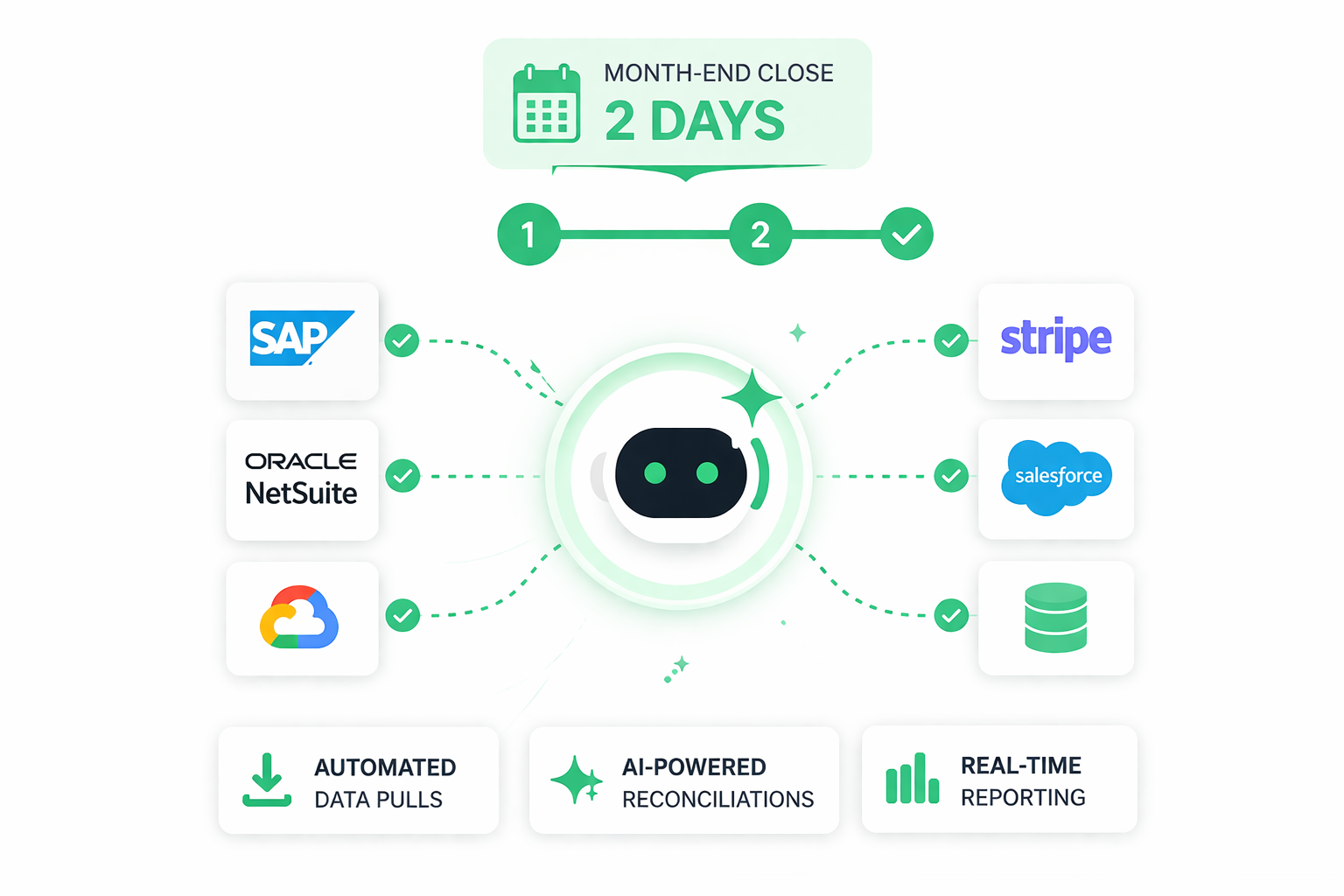
For most 8-figure SaaS companies, the Month-End Close isn't just a process: it is a crisis. Between manual 3-way matching, Stripe-to-NetSuite discrepancies, and chasing department heads for accruals, the average Finance team spends the first 10 days of every month looking backward instead of forward.
In the 2026 fiscal environment, "close velocity" is a primary competitive advantage. This case study explores how one enterprise finance team moved away from the rigid, manual "recipe" model of legacy middleware to an Agentic Finance Worker, shrinking their close cycle from 10 days to just 48 hours.
80%
Faster Close
100%
Audit Ready
$0
Task Tax
The Challenge: The Hidden Costs of Manual Reconciliation
Before deploying Engini, the finance team operated on a reactive basis. Despite having a top-tier ERP and a standard iPaaS, the "Last Mile" of finance remained stubbornly manual. The bottleneck wasn't a lack of connectivity; it was a lack of Orchestration Intelligence.
The primary challenges included:
- Unmatched Transactions: Over 15% of Stripe payouts required manual lookup to match against NetSuite records.
- Broken Accruals: Departmental expenses were submitted via fragmented channels, leading to a 3-day "chasing period."
- Integration Fragility: Every time a field was updated, legacy "recipes" broke, requiring 48 hours of IT intervention to fix.
Strategic Comparison: Legacy iPaaS vs. Engini Agentic Close
| Close Process | Legacy Method (10 Days) | Engini Agentic Engine (2 Days) |
|---|---|---|
| Bank Reconciliation | Batch processing at month-end. High error rate. | Continuous "Soft Close" running 24/7. |
| 3-Way Matching | Human verification of PO vs. Receipt vs. Invoice. | Autonomous Matching with 99.9% accuracy. |
| Maintenance | High manual overhead to update recipes during upgrades. | Self-Healing AI that monitors system changes. |
| Board Reporting | Finalized on Day 12-15 of the following month. | Live Visibility by the morning of Day 3. |
The Solution: Orchestration Intelligence for Finance
The CFO bypassed traditional middleware and deployed an Engini AI Worker designed for the Order-to-Cash (O2C) lifecycle. Unlike a standard integration, this agentic engine understands the intent of financial records and GAAP principles.
Step 1: Continuous Bank Reconciliation
Engini was configured to monitor bank feeds in real-time. Instead of waiting for Day 1 of the new month, the agent performed daily matches. By the time the "Close" officially started, 95% of the reconciliation was already finished.
Step 2: Self-Healing ERP Mastery
Because the agentic worker monitors the state of the ERP (NetSuite) and the Billing engine (Stripe) in real-time via our native connector, it identifies schema shifts instantly. Instead of breaking, the workflow adapts, ensuring the audit trail remains unbroken.
Expert Insight: The Shift from "Connecting" to "Doing"
From the Engini Solutions Team: Integration is a solved problem. The new frontier is Agentic Execution. Gartner’s 2025 iPaaS Market Study indicates that enterprises are moving away from platforms that require manual "recipe building" in favor of those that offer autonomous decision-making layers.
Frequently Asked Questions (FAQ)
1. How does Engini handle complex 3-way matching?
Engini utilizes Agentic Reasoning to compare POs, receipts, and invoices. It doesn't just look for field matches; it understands the context of the transaction to resolve discrepancies autonomously.
2. Can Engini work with customized NetSuite or SAP environments?
Yes. Our native, context-aware connectors are designed to navigate deep, highly customized ERP data layers without requiring specialized developers.
3. How secure is the Finance Worker?
Engini utilizes enterprise-grade Identity-Bound Execution, ensuring every action taken is compliant with your existing security policies and adheres to ISO, GDPR, and SOC 2 standards.
Quantify Your Savings
Measure the human work hours reclaimed by your first autonomous worker.
Run ROI Calculator